

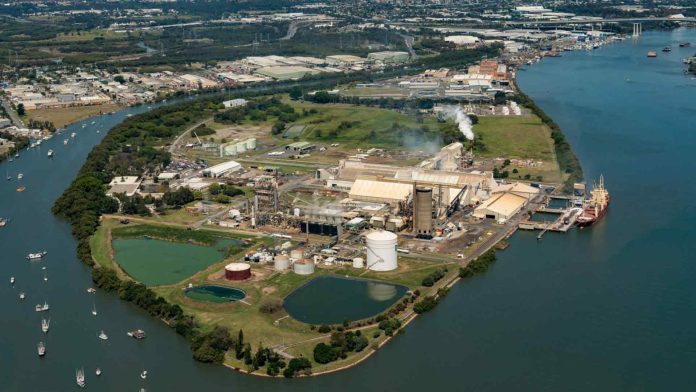
Fortescue Future Industries (FFI) and Incitec Pivot Limited (IPL) will move forwards with plans to convert IPL’s Gibson Island ammonia plant to run on green hydrogen.
The proposed plan could include the construction of a new 500 MW hydrogen electrolysis facility at the location to produce green hydrogen in addition to the retrofitting of IPL’s existing ammonia manufacturing facility to run on the green hydrogen produced onsite. Studies have confirmed the project’s viability.
IPL’s Gibson Island facility will stop producing conventional fertilisers early in the new year. The conversion of the Brisbane ammonia manufacturing and the port facility would be a world first as part of IPL’s decarbonisation strategy and in keeping with FFI’s objectives to aid heavy industry in decarbonising.
IPL Managing Director and CEO Jeanne Johns stated that the business was glad to pave the way for the Gibson Island ammonia manufacturing facility to a more sustainable future once traditional fertiliser production ceased.
Because it runs on green hydrogen, the facility may eventually create up to 400ktpa green ammonia, which could be exported to worldwide markets, used in fertiliser, or utilised to assist in decarbonising the local industry by serving as a low-carbon fuel supply for ports, airports, and heavy transport.
Front End Engineering Design (FEED) is a vital stage in development that will firm up technical requirements and costs, support procurement, and mature the project to the Final Investment Decision (FID), scheduled for 2023. The FEED phase is expected to cost roughly $38 million, with the Federal Government providing $13.7 million through the Australian Renewable Energy Agency (ARENA).
FFI CEO Mark Hutchinson said prior to FID, around 100 jobs would be supported across the project; the first production, pending FID, is anticipated to begin around 2025.
“Progressing this project into this final assessment stage is an important milestone in what will be a world-first conversion of an existing facility to become an industrial-scale producer of green hydrogen and green ammonia,” Hutchinson stated.
Hutchinson added that through the partnership, Queensland and Australia hope to lead the pack in terms of the quantity of green hydrogen and green ammonia produced and supplied as well as in terms of showing the rest of the world that such projects are feasible and that Australia has the foresight, the commitment, and the know-how to fund and carry them out.
“We’re so pleased to have the support of a partner in IPL who are as invested as we are in developing real-world solutions to reduce our reliance on fossil fuels, and equally appreciate the support of the Federal Government who are a key enabler of us progressing the project to its final development phase,” Hutchinson said.
According to Johns, today’s announcement was a big step in the right direction for sustainability, with IPL and FFI leading the way internationally.
“The potential conversion of Gibson Island to green ammonia shows our commitment to pursuing opportunities to help create a more sustainable world in the new and emerging opportunities stemming from green ammonia,” Johns said.
FFI and IPL are also collaborating with the Queensland Government to determine how the project might promote the achievement of the State Government’s overall development goals and the local energy markets’ needs.
Mick de Brenni, Queensland’s Minister for Energy, Renewables, and Hydrogen, praised the investment and noted that it builds on Queensland‘s significant overall accomplishments.
“Through actions of the Palaszczuk and Albanese Governments, we are building a clean energy ecosystem to facilitate onshore manufacturing, starting with the world’s largest electrolyser plant in Gladstone and now a potential green hydrogen facility to support local manufacturing in Brisbane too,” Minister de Brenni said.
Soon, applications will be submitted for the project’s planning permission. FFI is collaborating closely with Urban Utilities on a sustainable water supply for the project and Powerlink to connect the project to Queensland’s power transmission network. A national and international process is currently in progress to find possible customers for the green ammonia that the factory will produce.





 and Incitec Pivot Limited (IPL) will move forwards with plans to convert IPL's Gibson Island ammonia plant to run on green hydrogen.)