

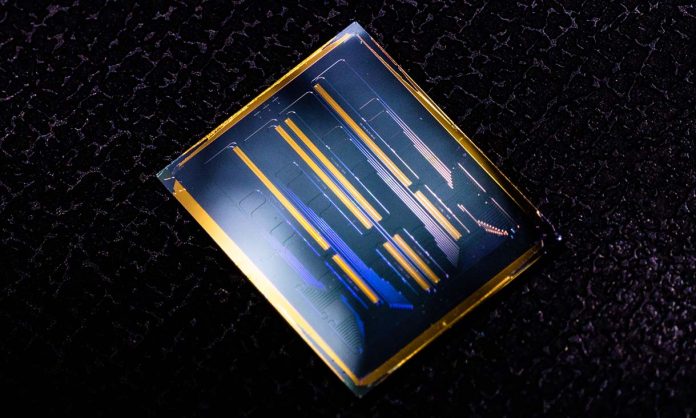
Leading scientists in the field predict that the new ultra-thin chips built of lithium niobate will eventually replace silicon chips in light-based technologies, with potential uses including moon navigation and remote detection of fruit ripeness.
The scientists claim that the artificial crystal offers the platform of choice for these technologies because of its better performance and recent improvements in manufacturing capabilities.
The team of global specialists, led by RMIT University‘s Professor Arnan Mitchell and the University of Adelaide‘s Dr Andy Boes, reviewed the capabilities and prospective applications of lithium niobate in the journal Science.
The global team, which includes researchers from China’s Peking University in China and US’ Harvard University, is collaborating with industry to develop navigation technologies that will assist rovers in driving on the Moon later this decade.
Because GPS technology cannot be used on the Moon, navigation systems in lunar rovers must employ an alternative system, which is where the team’s innovation comes in, according to RMIT University.
Professor Mitchell said the lithium-niobate chip could assess movement without requiring external signals by sensing minute changes in laser light.
“This is not science fiction — this artificial crystal is being used to develop a range of exciting applications. And competition to harness the potential of this versatile technology is heating up,” Professor Mitchell stated.
“We are focused on navigation now, but the same technology could also be used for linking internet on the Moon to the internet on Earth,” he added.
According to RMIT University, the new technology could also be used to detect fruit ripeness.
Professor Mitchell said light in the mid-infrared band absorbs the gas released by ripe fruit.
“A drone hovering in an orchard would transmit light to another which would sense the degree to which the light is absorbed and when fruit is ready for harvesting.” Professor Mitchell stated.
Professor Mitchell added that the microchip technology is significantly smaller, less expensive, and more accurate than the current technology, and it can be used with extremely small drones that will not harm fruit trees.