
Monash University startup ElectraLith is developing a membrane-based system to filter lithium from brine, allowing extraction from salt lakes, mine tailings, and other brine solutions using solar power and no chemicals or water.
ElectraLith aims to usher in a new age of lithium extraction by using the power of cutting-edge electro-filtration membrane technology, driving the battery market towards a cleaner, cheaper, and faster future.
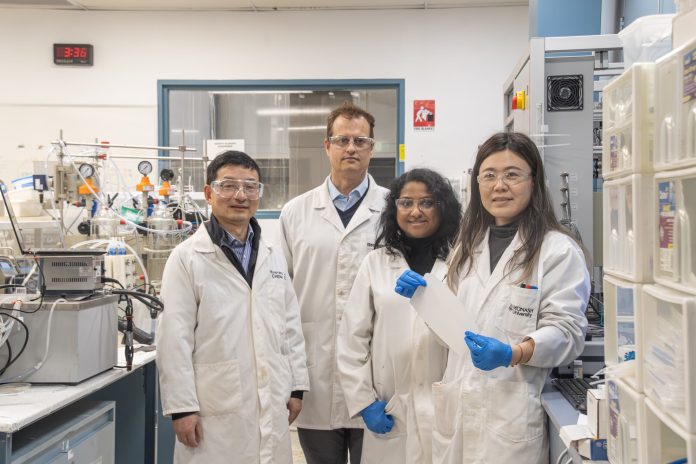
Director of the ARC Research Hub for Energy-efficient Separation at Monash University’s Department of Chemical and Biological Engineering and an Australian Laureate Fellow Professor Huanting Wang is at the forefront of the technology. According to Monash University, Professor Wang’s work in nanostructure membranes laid the groundwork for ElectraLith’s game-changing technology.
“Current lithium extraction methods involve either roasting hard rock at high temperature and dissolving it with hot sulfuric acid, or evaporating brines in a solar pond, both of which use chemicals to precipitate lithium out. It is time consuming, disruptive, expensive and wasteful. My research in nanostructure membranes is all about efficiency and ingenuity to make the most of this limited mineral resource” Professor Wang said.
Dr Zhouyou (Emily) Wang of Monash Engineering has been granted an Australian Research Council (ARC) Early Career Industry Fellowship to further develop and market the novel membrane-based technology that has the potential to revolutionise the lithium mining and recycling industries.
“Even though seawater is a brine, the concentration of Lithium is too low for cost effective extraction, but we are already thinking about designing the next generation of membranes to improve Lithium extraction, so maybe in the future we can extract Lithium from new sources,” Dr Wang said.
ElectraLith has been chosen by Australian technology incubator Cicada Innovations, the two-time winner of ‘Top Incubator in the World,’ to showcase its technology at the newly-named Cicada x Tech23.
ElectraLith was chosen from over 130 applications throughout Australia as one of the ‘Tech23’ to propose solutions on sustainably changing global mineral supply chains at the conference in July.
According to Monash University, lithium is a critical mineral, and its demand is increasing due to its widespread application in large-scale batteries for electric vehicles and renewable energy storage. To meet this exponential expansion, lithium supply is expected to expand by up to 800%, or nearly one million tonnes per year, by 2050, making the need for effective extraction technologies more crucial than ever.
ElectraLith’s Chief Technology Officer Dr SJ Oosthuizen commented, “ElectraLith’s team of materials scientists and electrochemists are grateful for the opportunity to discuss the company’s transformative technology at this esteemed event.”
“We are honoured to demonstrate how scientific innovation can profoundly improve how we produce, use and recycle critical minerals— all while maintaining sustainability and saving costs,” Dr Oosthuizen said.
The new technology is compatible with renewable energy and has the potential to lower lithium production costs by up to 40%, making onshore processing more competitive with the lowest energy need and environmental impact of all lithium refining technologies.