

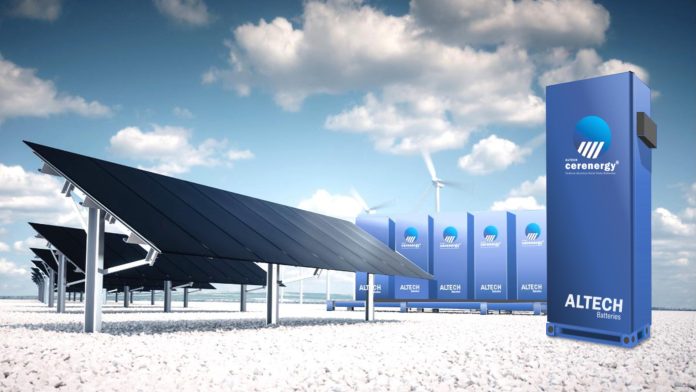
Altech Batteries Limited has commissioned the Centre of International Climate and Environmental Research (CICERO), affiliated with the University of Oslo, for a green certification of the CERENERGY® battery and project.
Altech has hired CICERO to perform an external review of its environmental credentials. CICERO is well-known for its competence in conducting impartial assessments of green credentials, notably in the green bond market. The Company previously sought CICERO accreditation for their Silumina AnodesTM project, which achieved a “Light Green” rating.
The relevance of efficient energy storage systems is quickly increasing as the global energy sector transitions to renewable energy sources. Grid storage batteries have emerged as a highly promising solution to renewable energy sources’ intermittent and variable nature.
Altech said it is fully aware of this trend and has deliberately concentrated its efforts on the grid storage battery industry, specifically targeting this sector with its unique Sodium-Chloride Solid State CERENERGY® batteries. While lithium-ion batteries presently dominate the rapidly growing grid storage market, the following research compares the carbon footprint of the CERENERGY® battery to its competitors.
The “Life Cycle Assessment of Sodium-Nickel-Chloride Batteries (CERENERGY® batteries)” study was conducted by the Sustainable Technologies Laboratory at Bochum University of Applied Sciences on the ecological implications of various battery types, including lead acid, lithium-ion, and sodium-chloride CERENERGY® batteries. The study examined greenhouse gas emissions and end-of-life considerations, including waste management and battery lifespan.
CERENERGY® batteries have a lower greenhouse gas footprint than lithium-ion batteries, with a life cycle evaluation revealing a 50% reduced footprint. These batteries do not rely on critical metals like lithium, cobalt, copper, graphite, or manganese, which are linked with substantial emissions from mining and extraction operations. These batteries employ sodium chloride and nickel instead.
According to Altech, the CERENERGY® battery plant in Saxony, with a capacity of 100 MWh, intends to minimise its carbon footprint by using renewable energy sources. The tunnel kiln for sintering ceramic tubes will be operated by electricity, and the facility will use no natural gas. The entire power need of the facility is around 5 MWh, and discussions are underway to acquire a renewable power supply.