

Artificial intelligence (AI) might hold the key to feeding 10 billion people by 2050 in the face of climate change and fast-developing pests and pathogens, according to University of Queensland (UQ) researchers.
UQ Queensland Alliance for Agriculture and Food Innovation (QAAFI) Professor Lee Hickey said AI offers prospects to speed the creation of high-performing plants and animals for improved farm sustainability and profitability.
“Breeders are collecting billions of data points, but the big challenge is how we turn this colossal amount of data into knowledge to support smarter decisions in the breeding process,” Professor Hickey stated.
“AI can help to identify which plants and animals we use for crossing or carry forward to the next generation,” he added.
According to Co-inventor of genomic prediction Professor Ben Hayes, the QAAFI team discovered four AI applications in crop and livestock breeding.
“The first one is deciding what to breed — it might sound simple, but this decision is becoming more complex. In an increasingly challenging environment, consumer acceptance will be more important, so AI is a good way to pull together the preferences of millions of people,” Professor Hayes said.
He stated that the second use includes large-scale image analysis to capture genetic variation across related lines of plants and desired animal features.
“The third area is to take genetic markers and use that information to predict how good a variety is going to be for breeding,” he noted.
Professor Hayes said the fourth use was changing the way researchers approached breeding.
“It’s a change from looking at individual genetic lines to thinking about a breeding population as a collection of chunks of DNA that are good for a trait,” he added.
“You might have one good chromosome segment in a line that is otherwise not so good, but AI can identify the optimal crossing path to combine it with other segments across the genome and develop a new and superior genotype,” he explained.
“The crosses needed to bring together the AI selected beneficial segments can be progressed rapidly using ‘speed breeding’ which allows researchers to turn over multiple generations very quickly,” he continued.
Professor Hayes said AI-informed selection combined with speed breeding enables researchers and breeders to develop considerably improved genotypes available for assessment in as little as a year or two.
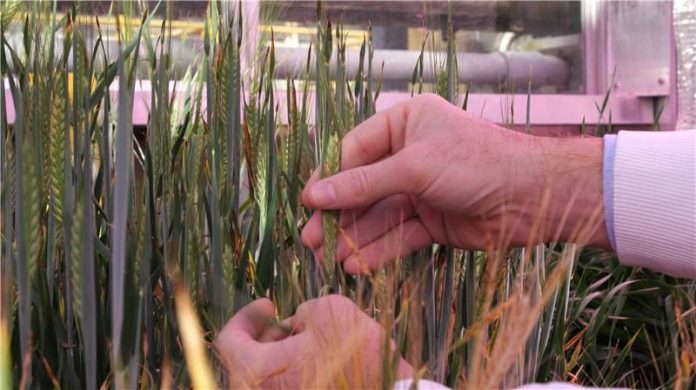
UQ researchers are already merging speed breeding and AI in wheat and barley initiatives funded by the Grains Research and Development Corporation (GRDC) in conjunction with the Queensland Department of Agriculture and Fisheries.
“Integrating speed breeding with genomics and in particular AI is the new frontier in plant and animal breeding, where we tap into these big data sets,” Professor Hickey said.
“This will be a game changer, bringing desirable traits together faster than ever before, particularly when it comes to multiple traits governed by multiple genes,” he added.