
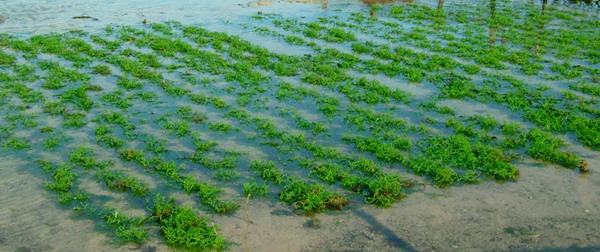
Despite being a $6 billion global industry, Australia has barely begun to explore the thousands of species of seaweed and their potential as food, medicine and agricultural products.

Image credit: Flickr User: Bali Hotels and Villas
Dr Pia Winberg, a marine biologists and director of the Shoalhaven Marine and Freshwater Centre at the University of Wollongong, has been at the forefront of international research on seaweed.
According to her, Australia needs to explore its vast family of seaweeds and capitalise on its incredible potential in the food, medical and agricultural industry.
“We really don’t know a lot about Australian seaweeds because just as we have unique gum trees, kangaroos and things on our continent, we have equally unique seaweeds. We can introduce some unique Australian seaweeds and unique molecules from seaweeds to the world that we really haven’t seen before,” Ms Winberg said in an interview for the ABC.Net.
“The one thing that’s really unique about seaweeds is the slime in them, the gel-ness in them. Seaweeds don’t have vascular tissue to move water around them like trees and flowers do. They have to have a whole lot of cells stuck together with this gel-substance that actually acts as a transport, communication and a defence system in the seaweeds.”
Professor Gordon Wallace from Wollongong University said they had been looking at extracts from seaweeds that form the structural component of 3D printed parts which they used in studies for nerve and muscle and bone and cartilage regeneration.
“Those structures contain the patient’s own stem cells that are printed using our 3D printers, but also requires a structural component to encase those cells and to provide mechanical integrity and these extracts from seaweed help us to do that,” Professor Wallace said.
“We really are just scratching the surface at the moment. It’s exciting to think about the future, about how we might be able to extract specific biomaterials for specific applications and to tailor how those materials are produced for a certain type of 3D printing.”
The University of Wollongong has also been studying the chemical profile of Australian seaweed varieties for their potential in gut health, treating conditions such as Crohn‘s disease and certain types of cancer.
“Seaweeds have been shown to have numerous activities – anti-cancer, anti-inflammatory, antioxidant, and we’ve found our own species are also a source of these compounds,” said Janice Mccauley from Wollongong University.
“We’ve also got the potential for selective anti-cancer potential as well.”
Marine biologists claim that Australia is well-placed with its high regulatory standards to set up smart systems and quality control systems to export its biomass and knowledge in this area to the world.
Click here for the full interview.