
A new study sheds light on the critical role gas plays in the national economy, in each state and territory, and its indispensability in building our contemporary manufacturing base.
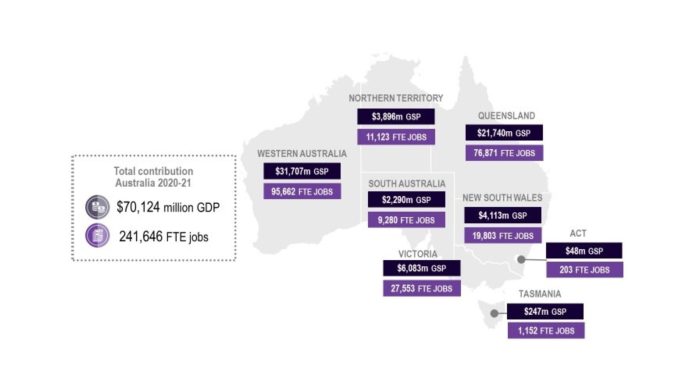
According to an economic analysis conducted by ACIL Allen Consulting for Gas Energy Australia, gas creates over $70 billion in domestic economic activity every year, accounting for 3.4 per cent of GDP, while sustaining over 241,600 Australian jobs — 2.25 per cent of all occupations. It is expected to expand significantly next year.
Gas Energy Australia CEO Brett Heffernan said a future constructed in Australia would be based on gas and, increasingly, renewable net zero gases.
“These figures are conservative as they do not include the commercial use of gas in the economy, such as cafes, restaurants, forklifts and the like. We know they add to gas’ economic contribution, but official government data and modelling becomes sketchy at this point in the supply chain, so has been omitted,” Heffernan stated.
Heffernan added that aside from gas production, which is the most important economic driver in Australia, with over $40 billion in revenue and 109,284 Australian jobs, the report emphasises the importance of gas to Australia’s electric power generation and its indispensable role in manufacturing, for both industrial heat and feedstock.
According to the report, gas contributes the following:
- $4.11 billion in electricity generation and 12,289 jobs;
- $5.14 billion in high-temperature manufacturing and 24,205 jobs; and
- $7.75 billion in chemical feedstock for manufacturing and 33,074 jobs.
“Either for industrial heat in excess of 800 degrees Celsius, which electricity cannot muster, to process the things we all use like glass, bricks, ceramics and alumina, or as a feedstock (ingredient) in making plastics, fertilisers, pharmaceuticals, rubber, propellants, refrigeration, adhesives, cosmetics, to list just a few… gas cannot be replaced. It is, and will continue to be, essential,” Heffernan said.
Heffernan stated that Australian governments are pushing ahead into a brave new world where intermittent renewables will ideally be able to meet all current energy needs, as well as the expanding demands of new homes and businesses, electric vehicles, buses, and small truck fleets, as well as the gap left by coal’s abrupt removal from the grid.
“To be clear, we support solar, wind and batteries. They will provide power… some of the time. As governments move to rely more and more on these sources, increasingly they will need gas – including renewable, net zero gases – to fill inevitable gaps,” he added.
Heffernan said gas is a reliable energy source, but its security and close proximity to net zero emissions make it more than just the much-needed backup for electrical networks.
“Produced in perpetuity, emerging green gases can supply existing home appliances and commercial equipment, making gas the most secure choice of all renewables. Sticking with gas will save homeowners and businesses tens of thousands of dollars each, negating the need to switch to overburdened and less reliable electricity, while still achieving net zero by 2050,” he stated.
According to Heffernan, biomethane, derived from organic waste, is already manufactured in Australia and utilised to generate power. He said the next phase is to decarbonise gas networks, with Sydney Water and Jemena trying to inject biomethane into the gas distribution network.
He added that Hydrotreated Vegetable Oil is a diesel-like fuel processed to create Sustainable Aviation Fuel from renewable waste. He said it would be a significant new industry in Australia, producing renewable LPG as a byproduct. Several sites are already in the works across the country.
“Whether we realise it or not, gas is, and will remain, an intrinsic feature in all of our lives. Be it a sneaky snag at Bunnings on the weekend, families snug by the heater in winter, fuelling entire communities and industries in meeting their everyday needs, Australian gas is here to stay,” Heffernan said.
ACIL Allen has mapped the national economy’s and states’ gas footprints to provide a clear picture of Australia’s reliance on gas. According to the research, these figures are Covid-affected, so they are lower than typical, but they are expected to climb significantly next year.