
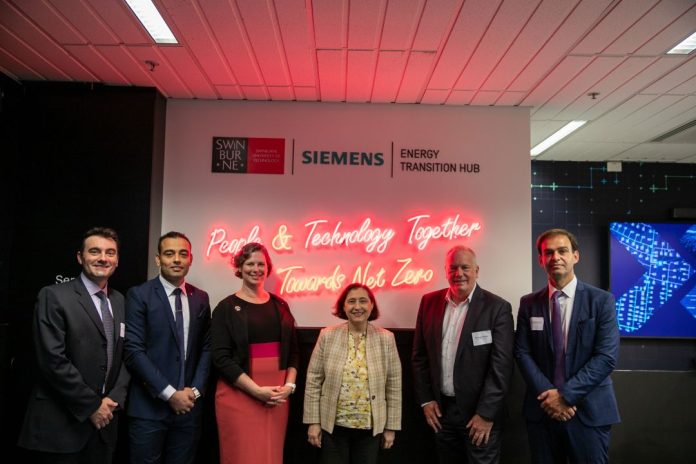
Victorian Minister for Energy and Resources Lily D’Ambrosio has officially launched the $5.2 million Siemens Swinburne Energy Transition Hub.
The energy hub will establish a future energy grid laboratory equipped with advanced Siemens digital technology to tackle challenges within Victoria’s renewable energy transition.
According to the Swinburne University of Technology, the hub will leverage Siemens and Swinburne’s extensive digital energy technology expertise to design reliable solutions, create opportunities, and facilitate groundbreaking activities.
“Australia’s ambitious carbon reduction targets need a multipronged approach by industry, research and government. The new Seimens Swinburne Energy Transition Hub will be working on new technologies to improve efficiency, supply, integration, storage, transport and use, as well as how we can improve existing technologies and frameworks,” Swinburne Vice-Chancellor Research Professor Karen Hapgood said.
“We need change fast, and the Siemens-Swinburne team will focus on taking ideas to market – where they can make the most impact as quickly as possible,” Professor Hapgood added.
The hub, led by Associate Professor Mehdi Seyedmahmoudian of Swinburne’s School of Software and Electrical Engineering, would house a digital twin of Australia’s energy market, allowing commercial research teams to run simulations of innovative solutions.
The energy hub will:
- Promote environmental and social sustainability through the implementation of sustainable energy solutions.
- Contribute to Australia’s carbon reduction targets and global energy transition initiatives.
- Equip future generations with the necessary knowledge and skills in advanced energy technologies.
- Promote collaborations between industry and academia to foster economic growth and innovation.
- Accelerate the transition towards next generation electricity grid systems.
Siemens Australia and New Zealand CEO Peter Halliday said industry and academia partnerships are vital for achieving better outcomes on national issues like the energy transition.
“The race to tackle climate change is real and of utmost importance Australia’s contribution to global emissions is just over 1 per cent. As industry and as a society, we should be focusing on reducing our emissions beyond the 1 per cent, using digitalisation as the key lever to driving long-term sustainability. The hub is a great example of how the best minds can collaborate to help shape the future,” Halliday stated.
According to Minister D’Ambrosio, Victoria is on track to achieve 95% renewable energy generation by 2035 and net zero by 2045, utilising innovative digital technologies to achieve the goal.
“By expanding and modernising our grid, we will enable cheaper, more reliable renewable energy to be delivered to homes and businesses across Victoria,” Minister D’Ambrosio added.