
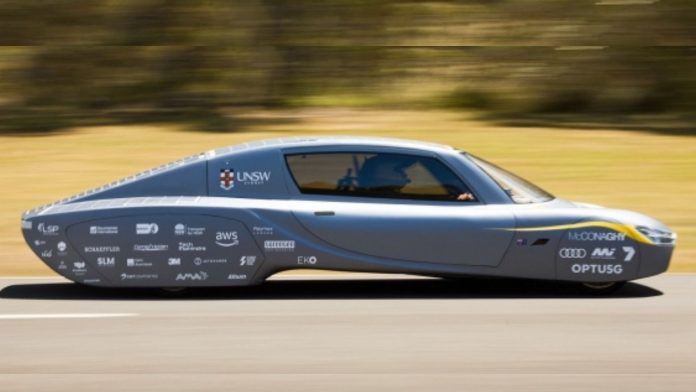
UNSW Sydney‘s Sunswift 7, a student-built solar-powered car, is set to compete in the Bridgestone World Solar Challenge, covering over 3500km from Darwin to Adelaide.
Sunswift already holds a Guinness World Record for travelling 1000 kilometres on a single charge in less than 12 hours in December 2022.
In another technological breakthrough, the team will use Elon Musk’s SpaceX Starlink system to livestream continuous footage from inside the car, returning to UNSW Sydney as it races.
The Sunswift car will be equipped with 5G transmission from Optus and Cradlepoint and AWS cloud computing services to transmit live video feeds via Starlink satellites to a large screen on the UNSW campus.
The car’s telemetry will be relayed back to student engineers working as race control from special Spacecube modular buildings located in the middle of the campus.
Former Head of Operations at Red Bull F1 team and Sunswift Racing Team Principal Professor of Practice Richard Hopkins compares the latest development to NASA’s space missions.
“We will have a race control team back on campus at the university checking all the telemetry and data from the car. It’s very much like NASA’s mission control where all the people in Houston are able to monitor what is happening when the rocket goes into space,” Professor Hopkins said.
“This is about showcasing the technologies and showing we can broadcast video from the middle of nowhere and livestream that back to a jumbo screen on campus for people to cheer us on,” Professor Hopkins stated.
The Sunswift Racing team will attempt to score a perfect ten in the World Solar Challenge, but this may be their final appearance at the famous event.
The student team, having participated in the race nine times since 1996, will compete in Darwin on 22 October to compete in the epic race to Adelaide.
However, planning for Sunswift 8 is underway, with the team intending to incorporate advanced hydrogen fuel cell technology, but current regulations may prevent them from participating in future World Solar Challenge races.
Professor Hopkins plans to meet with event organisers and other teams in Darwin to consider if the rules could be updated in the future to guarantee the race maintains true to its mission of pushing the frontiers of technological innovation.
“The regulations for the WSC have basically been the same for the past 20 years. Innovation and technology have moved on so much in that same period of time, but these regulations have not been re-aligned in the same way,” he said.
He emphasised the need to be able to explore new technologies, such as silicon solar cells, as they offer numerous benefits, while technologies like gallium arsenide are currently restricted.
“There are lots of different battery technologies emerging, as well as new motor technologies, in addition to what we are already planning for Sunswift 8 in terms of including hydrogen fuel cells,” he stated.
“I think it would be great to have more freedom because the world has moved on and the WSC regulations maybe need to move with the times as well,” he added.
Professor Hopkins advocates for UNSW students involved in the Sunswift project to excel in automotive design and construction, aiming to showcase their expertise globally.
“If we choose to build Sunswift 8 to the current WSC regulations it would just be pretty much the same car, with the same technology, and the learning outcomes for the students would also be the same,” he said.
According to him, the UNSW Sunswift team can effectively tackle significant automotive issues through innovative solutions, but if they are restricted from exploring these ideas, their relevance may decline.
“I’d like to be part of a conversation with all the teams and the WSC organisers to gauge what everyone thinks and discuss what might be possible in terms of amending the regulations, if that’s what the consensus agrees with,” he added. “I don’t profess to have all the answers myself, but if I had the chance to sit down with other likeminded people, I think we definitely could come up with a really nice set of updated regulations.”
“Our goal has been to engineer the best solar electric car we possibly can. And if we’ve done it to the highest level then the net result should be winning the World Solar Challenge – which is what we are going there to do,” Professor Hopkins added.