
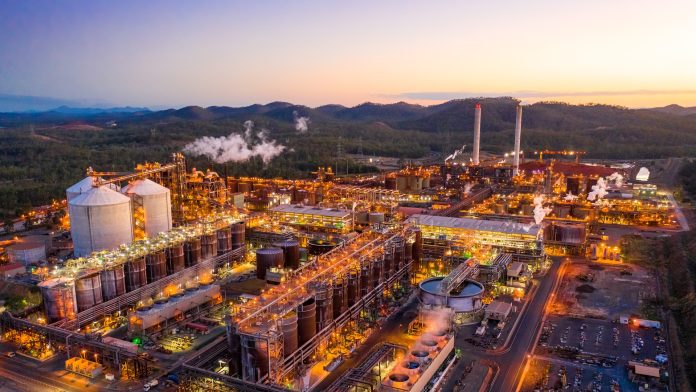
The Australian Renewable Energy Agency (ARENA) has awarded Rio Tinto and Sumitomo Corporation a $32.1 million grant to trial hydrogen calcination technology at the Yarwun Alumina Refinery.
According to ARENA, the $111.1 million ‘Rio Tinto and Sumitomo Corporation Yarwun Hydrogen Calcination Pilot Demonstration Program’ will be the world’s first deployment of hydrogen calcination.
The initiative aims to reduce emissions in alumina refining, which presently accounts for around 3% of Australia’s greenhouse gas emissions.
The project will include a 2.5 MW on-site electrolyser to supply hydrogen and the conversion of one of the refinery’s calciners to use a hydrogen burner.
Sumitomo Corporation will own and operate the electrolyser at Rio Tinto’s Yarwun Alumina Refinery, as well as deliver hydrogen directly to Rio Tinto. The electrolyser will have a capacity of more than 250 tonnes of hydrogen per year.
Rio Tinto will put the hydrogen calciner through a series of tests under varying operating circumstances to ensure its compatibility and performance.
Calciners, which employ high temperatures to remove chemically bonded water from alumina crystals, have traditionally used fossil fuels for process heat, accounting for around 30% of alumina refining emissions.
Hydrogen calcination also generates high-purity steam, which, unlike contaminated steam produced by fossil fuel calcination, may be recovered for use in subsequent stages of the refining process.
If the initiative is successful, it will establish the practicality of hydrogen calcination and pave the way for its widespread implementation in other alumina refineries.
The demonstration comes on the heels of Rio Tinto’s successful feasibility study, which ARENA funded with a $580,000 grant in 2021.
According to ARENA CEO Darren Miller, the initiative represents a significant step towards the development of hydrogen calcination and the decarbonisation of the alumina manufacturing process.
“This world-first pilot looks to prove a promising technology for decarbonising one of our most emissions intensive industries,” Miller said.
“If this pilot project is successful, it could be a game changer for Australian alumina production, paving the way for deployment across the industry, and underscoring the importance of low-cost green hydrogen to decarbonise our largest industrial emitters. ARENA will continue to support projects at this scale as we develop other larger programs, such as Hydrogen Headstart,” Miller stated.
Hydrogen calcination was highlighted as one of four technologies that might cut emissions from Australia’s alumina refineries by up to 98% in ARENA’s Alumina Decarbonisation Roadmap (the Alumina Roadmap), which was released in 2022.
Since 2021, ARENA has been investing in projects to reduce emissions from the aluminium supply chain. This includes funding for Alcoa to research electric calcination and to test mechanical vapour recompression, two more technologies mentioned in the Alumina Roadmap.