

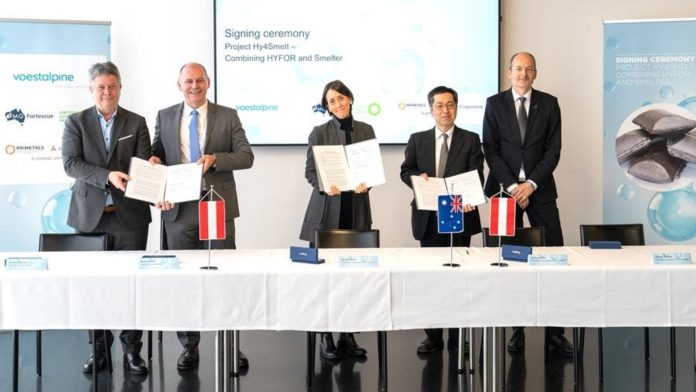
Fortescue, Primetals Technologies, Mitsubishi Corporation, and voestalpine have signed a Memorandum of Understanding (MoU).
The collaboration aims to design and engineer an industrial-scale prototype plant at the voestalpine facility in Linz, Austria, using a new net zero emission ironmaking technology. The collaboration will also look into the plant’s deployment and operation.
Primetals Technologies’ HYFOR and Smelter systems will be used in the new ironmaking process. HYFOR is the world’s first direct reduction method for iron ore fines, eliminating the need for agglomeration processes such as sintering or pelletising. Primetals Technologies has performed multiple successful test campaigns over the last year, including successful trials on Fortescue’s Pilbara iron ore products, and a pilot plant has been in operation since the end of 2021.
Primetals Technologies‘ innovative Smelter technology is a furnace that runs on electricity. It is employed in the melting, and final reduction of direct reduced iron (DRI) derived from lower-grade iron ores. It generates alternative green hot metal for the steelmaking facility in this manner.
“voestalpine has a clear plan to decarbonize steel production with the greentec steel program. An important first step is the incremental shift from the blast furnace route to a hybrid-electric steel pathway from 2027. Over the long term, our mission is carbon neutral steel production using green hydrogen, for which we are already undertaking intensive research into promising breakthrough technologies. With the joint project with Primetals Technologies and Fortescue, we are taking another new path towards achieving the goal of CO2-neutral steel production by 2050,” said Hubert Zajicek, Member of the Management Board of voestalpine AG and Head of the Steel Division.
Dr Alexander Fleischanderl, Senior Vice President and Head of Green Steel at Primetals Technologies, stated: “This is a decisive step for the transition to green steel production, and we are very excited to be a key part of it. Our HYFOR technology is a result of decades of work in the direct reduction and hydrogen space. The Smelter is another game-changing green technology we are developing. By combining these solutions, we will enable a sustainable technology for green ironmaking over the long term.”
The primary task of Fortescue in the new project is to supply expertise about iron ore quality and preparation. Fortescue will also supply various iron ores for the new plant.
“Fortescue has more than two decades of expertise in the iron ore industry, rising to become one of the world’s lowest cost exporters, now shipping more than 180 million tons of iron ore a year. Global demand for iron ore and steel will remain strong for years to come, but we need cleaner, greener industry powered by green energy to eliminate emissions,” Fortescue Future Industries (FFI) CEO Mark Hutchinson said.
During the project planning stage, an industrial-scale prototype plant with a capacity of three to five tonnes of green hot metal per hour will be designed. It is the first solution to connect a direct reduction facility for iron ore fines based on hydrogen with a smelter.
The primary purpose of the project planning phase is to provide the decision-making framework for realising a prototype plant capable of continuous operation, and then to gather the know-how required for the following stage, a full-scale commercial plant. Another goal is to look at the use of different types of iron ores to make DRI, hot briquetted iron (HBI), and hot metal and then draw conclusions regarding the individual process steps as well as different combinations of them.
The hydrogen used in the new plant will mostly originate from Verbund, Austria’s foremost renewable energy provider, which operates the H2Future proton exchange membrane (PEM) electrolyser. This facility, located in Linz, has a capacity of more than six megawatts and is still the world’s largest of its sort utilised at a steel company. The H2Future plant will be updated to enable hydrogen gas compression and storage before usage in the combined HYFOR and Smelter plant.






.)