

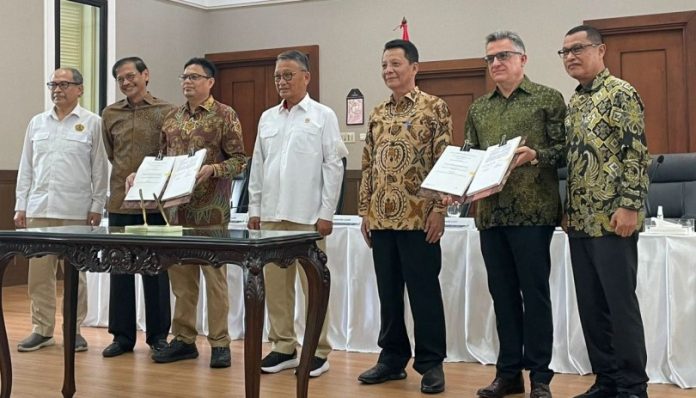
Conrad Asia Energy Ltd announced the signing of Production Sharing Contracts (PSCs) for the Offshore North West Aceh (Meulaboh) and Offshore South West Aceh (Singkil) PSCs located offshore north-west and south-west of Indonesia’s Aceh Province.
Conrad will operate both blocks and own a 100 per cent stake in them. According to Conrad, these acquisitions align with its primary strategy of developing assets with the potential to supply gas to South East Asia’s rapidly rising markets.
Two Joint Study Areas (JSAs) offshore the northwest and southwest of the Aceh Province were allocated to Conrad in November 2018. Meulaboh and Singkil were made available as part of the first licencing round of the Indonesia Petroleum Bidding Round (IPBR) 2022, for which Conrad submitted offers on 5 September 2022. The Indonesian authorities regard the blocks as “frontier” with corresponding fiscal arrangements that are attractive and favourable compared to Indonesian PSCs over blocks in more mature areas due to the deepwater environment and lack of exploration in large parts of each block, despite the existing discoveries in the shallow water. However, recent seismic surveys have identified promising lines with gas potential, and previous seismic has revealed flat spots and gas chimneys, which are signs of the existence of hydrocarbons in the deeper water zones, which have not yet been fully explored.
Conrad’s winning bids for both blocks were announced by Indonesia’s Ministry of Energy and Mines on 8 November 2022. The two new PSCs were signed by Conrad on 5 January 2023.
Each PSC has a total committed work program of $15 million, which includes geological investigations in 2023, 500 square kilometres of 3D seismic acquisition in 2024, and well drilling in 2025. According to Conrad, the costs of the 2023 obligations will be covered by proceeds from the Company’s recent IPO on the Australian Securities Exchange. Following actions will incur expenditures from various sources, including farm-in partners as the PSCs mature and the start of cash flow from the Mako gas field.
The PSCs have hydrocarbon potential near existing shallow water gas discoveries and in underexplored deep-water areas of the blocks. The water depths in the two operating regions range from 5 to 1,500 metres, with the existing findings lying at less than 100 metres.
The shallow water findings were made in the 1970s and are sited on geological structures known as “pinnacle reefs”. Conrad has begun third-party competent people reports on the known gas discoveries in both blocks. Based on conceptual development plans, these studies will include Contingent Resource estimations and appraisals.
According to the company, it has already found additional shallow-water leads, which will be further developed in the coming months following the acquisition of more 3D seismic data. Conrad’s shallow water gas discoveries have already found local market prospects in the near term. If successful, the larger projects in deeper water have the potential to feed South East Asia’s developing markets and are part of Conrad Asia’s ambitions to build a regional gas production firm in this fast-growing market.
Conrad Managing Director and Chief Executive Officer, Miltos Xynogalas, commented, “The award of these two PSCs is a transformational event for Conrad as these blocks contain discoveries that significantly increase our resource base and offer the opportunity for Conrad to add several gas projects to its existing large Mako gas project. Conrad’s initial scoping study of gas markets in the region has been positive and we are optimistic of commercialising these discoveries and delivering a portfolio of growth opportunities to our shareholders.”
Xynogalas said Conrad stands to benefit significantly from the exploratory potential in both shallow and deep water, where we have already discovered several high-impact gas plays. Xynogalas stated that deep-water locations could have several trillion cubic feet of gas leads, with evidence of hydrocarbon accumulations from observed gas chimneys and seismic flat spots. He added that the most promising leads are at 1,000 metres of water, which is shallow by world standards. According to Conrad, it owns a 100 per cent working interest in these blocks and will be looking for partners to help with exploration operations. Major corporations have expressed an interest in reviewing our data.
“We are delighted to have been awarded these PSCs, and to have matured the blocks from when we first started to evaluate them some four years ago. These blocks are consistent with our company strategy of being focussed on gas in offshore locations within Asia, in order to build our gas portfolio in the region, with potential to supply gas to the rapidly growing markets in South East Asia,” he said.
Conrad Chairman, Peter Botten, commented, “The markets for gas in the general Asian region and in particular Indonesia are very strong as the country has experienced strong economic growth over the past years. At the recent G20 meeting in Indonesia, the world pledged to finance Indonesia US$20 billion to help it transition away from coal. Gas is the important transition fuel in the fourth most populous country in the world. Indonesia is looking to double its gas production by 2030 and is actively encouraging the exploration and development of natural gas where it recently announced it would need some US$170 billion in upstream investment by 2030. Conrad is delighted to be an active participant in this important initiative to secure vital energy supplies in this growing economy.”







 for the Offshore North West Aceh (Meulaboh) and Offshore South West Aceh (Singkil) PSCs located offshore north-west and south-west of Indonesia's Aceh Province.)