
Peninsula Energy Limited presented an update on the status of its flagship Lance Projects in Wyoming, USA.
While ramping up pre-production wellfield conditioning flowrates, the Company is swiftly advancing final site construction. The Lance Projects are still on target to resume commercial uranium production by the middle of 2023.
“April felt like a turning point as the Lance Project team took delivery of several long lead-time items that were previously holding back progress. Field conditions have been favourable for construction activities and our contractors have substantially advanced the various work streams,” Peninsula Managing Director and CEO Wayne Heili said.
According to Heili, pre-production operations have also increased significantly. Preconditioning a large chunk of Mine-Unit One (MU-1) is underway before the production stream enters the recovery facility. Heili added that the company can now see the plant’s re-commissioning and commercial production at Lance Projects.
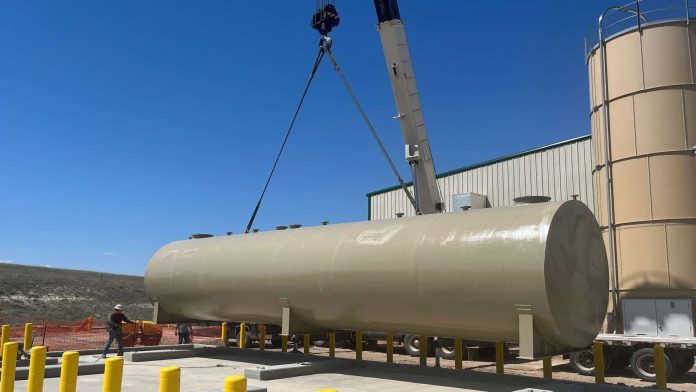
The project team continued low-pH ISR preparations in April. A construction company is installing concrete foundations and pedestals for high-capacity sulfuric acid and hydrogen peroxide storage and delivery systems. The first of two big acid storage tanks have been installed, and the distribution systems are being linked to plant addition sites. Installing a second acid tank. Inclement weather at the fabrication site has delayed the delivery of a high-capacity peroxide storage tank, but Lance has a smaller peroxide addition system that can maintain operations.
The current uranium recovery plant is being renovated in parts to be compatible with low-pH solutions. Contractors have begun removing the old equipment to prepare the facility for the new installations. The building work on the plant improvement is scheduled to be finished in June 2023.
As Peninsula previously stated, new ion-exchange resins have been procured to enable more effective uranium recovery in the process plant. Because the resin order had a considerable lead time, delivery was delayed. When the recovery facility is recommissioned, a significant quantity of fresh resin will be available.
Capital expenditure for the low-pH facility project transition is still closely tracking the August 2022 DFS plan, with no major departure expected. The DFS estimated that the CAPEX for the low pH transition and Stage-1 upfront expenses would be $8.4 million.
Previously, the company announced the construction of small-scale pre-production circulating flows utilising current chemical delivery systems. Well patterns in MU-1 are being acidified and prepared for production. A booster pump was delivered, installed, and commissioned, allowing for greatly increased recirculation flowrates for preconditioning. Currently, a flowrate of roughly 500 gallons per minute (GPM) has been established for operation. Flowrates will be boosted further in May and June.
The large-scale acid storage and distribution system is planned to be operational by mid-May. When fully operational, the new technologies will allow for larger acid concentrations, expediting preconditioning processes even more.
The preconditioning process stream is not currently being routed to the production plant, and no uranium is being collected in plant circuits. Uranium concentrations are expected to rise during the pre-conditioning process, and the processing facility is planned to be operational for commercial uranium production by mid-year 2023.