
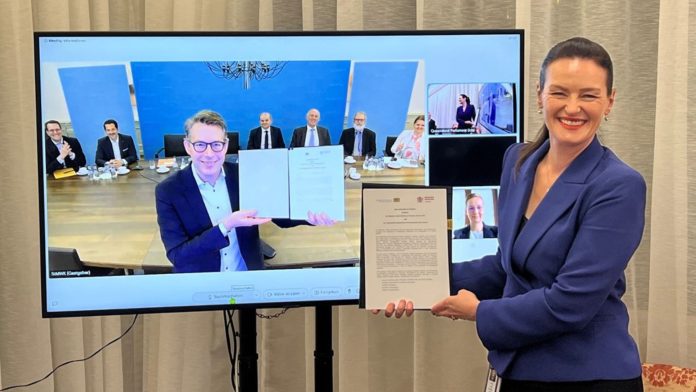
The Queensland and Bavarian state governments have inked a new science research agreement, aiding Queensland in its efforts to tackle climate change and achieve net zero emissions by 2050.
The new agreement formalises the two governments’ collaboration to fund joint university-level research on critical areas such as greener fuels, energy storage, and emission reduction technologies.
Queensland Science Minister Leanne Linard and Bavarian Science and Arts Minister Markus Blume signed the agreement via videoconference.
“This new collaboration in research topics closely relevant to the priorities of Queensland and Bavaria directly supports the economic development of both states. It will ensure both governments continue to strengthen existing international science partnerships and identify opportunities to develop new international partnerships to maintain our respective global reputations as science leaders,” Minister Linard said.
The agreement expands upon existing research and industry ties between the two states, including Queensland University of Technology‘s collaboration with the University of Bayreuth in Bavaria and the University of Queensland‘s partnership with the Technical University of Munich.
In June 2022, the Bavarian Government proposed formalised cooperation between the two state administrations to support university-level collaborative research on priority research topics.
“Both of us represent strong competitive economies and invest heavily in science and research, in Bavaria via the Hightech Agenda, a vast strategic program of 5.5 billion Euros in high-tech-related research and innovation,” Minister Blume said.
Green hydrogen, synthetic fuels, and energy storage are among the collaborative research priorities supported by the agreement, as are cleantech and emission reduction technologies, artificial intelligence, quantum technologies, additive manufacturing, life sciences, biomedical research, a wider bioeconomy, and aerospace.
Among other things, the agreement’s research opportunities will assist the State in developing a successful and resilient economy that controls the risks of climate change while capitalising on the numerous possibilities that come with transitioning to a net zero emissions economy.
Importantly, the agreement’s research priorities, including green and synthetic fuels, improved energy storage, emission reduction technologies, and bioeconomy, will aid the State in its pursuit of the Queensland Climate Action Plan 2030 targets.
“Bioeconomy, in particular, is an emerging model for government and business, with a greater focus on sustainably using renewable biological resources to produce food, energy, and industrial goods,” Minister Linard said.
This plan lays out a strategy for addressing climate change over the next decade, with the goal of achieving Queensland’s objectives of at least 50% renewable energy by 2030, 30% emissions reduction below 2005 levels by 2030, and finally net zero emissions by 2050.
“This new agreement represents an exciting step in Queensland’s broader relationship with Germany, where we are working together to provide solutions to some of the world’s challenges,” Minister Linard stated.
Minister Blume added, “Bavaria and Queensland are an unbeatable team. We are shaping our future together because we both know that we need to provide answers to pressing questions on a global scale.”