
In an Australian first, the CSIRO will develop an easily deployable device that will produce hydrogen directly at the point of consumption.
CSIRO scientists will construct a demonstration unit based on patented technology to efficiently generate hydrogen from liquid carriers with a $10 million investment from research and innovation provider Advanced Carbon Engineering over a six-year period.
According to the CSIRO, the use of a liquid carrier allows hydrogen to be securely and effectively stored and transported in tanks from the point of production – such as a remote solar or wind farm – to the point of usage.
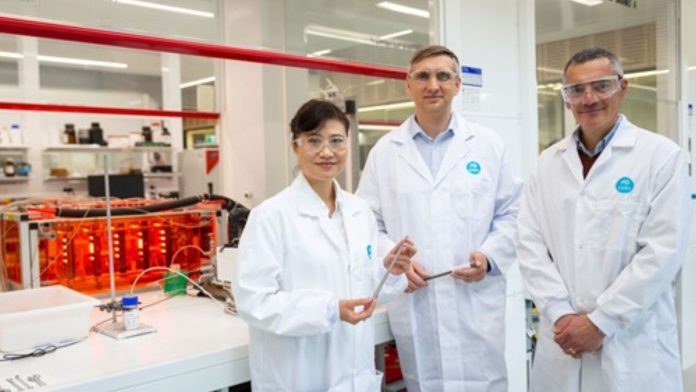
CSIRO Deputy Hydrogen Industry Mission Lead Dr Vicky Au said the project will be the first to use Australian technology to manufacture hydrogen from a liquid carrier, addressing some of the fundamental barriers to the growth of the hydrogen sector.
“Australia has the potential to become an energy superpower through hydrogen, but we need to find better methods of safely transporting and storing it at scale,” Dr Au stated.
“To get the hydrogen industry moving, we need to be able to get hydrogen where it will be used by the consumer. This generator unit will do just that and will be compact enough to move to where it’s needed – whether that’s a farm, a festival, an industrial facility or, a mine site,” Dr Au explained.
CSIRO Researcher Dr John Chiefari stated that the CSIRO’s patented catalytic static mixers will be critical in the development of the new hydrogen generator.
“Catalytic static mixers are special tools that mix fluids to speed up and better control chemical reactions without any moving parts. This level of control allows the process to be highly scalable without the technical challenges that this usually entails. This gives us a key advantage over the current packed bed reactor technology,” Dr Chiefari said.
According to Dr Chiefari, the technology for incorporating hydrogen into a carrier fluid is currently in place. Dr Chiefari noted that with the hydrogen-generating technology, hydrogen can be created locally and on-demand from the carrier, with the added benefit of the carrier fluid being safely stored in the same manner as diesel or gasoline.
“This would be a big step forward with a goal to be able to store the fuel in standard tanks and manage it using existing diesel or petrol infrastructure,” he added.
Advanced Carbon Engineering CEO Jon McNaught stated that the company is developing national capacities by undertaking important research, encouraging unique discoveries, and establishing new sectors.
“Innovation is vital for humanity’s future, driving progress and economic growth, solving challenges, creating opportunities, and ensuring a sustainable future for generations,” McNaught said.
The study is being carried out as part of CSIRO’s Hydrogen Industry Mission, which aims to help global decarbonisation by developing a commercially viable Australian hydrogen sector.
The clean hydrogen sector will provide 16,000 jobs by 2050, plus 13,000 from renewable energy infrastructure building, according to Australia’s National Hydrogen Strategy. By 2050, Australian hydrogen generation for export and local consumption may earn more than $50 billion in GDP and save greenhouse gas emissions equivalent to a third of Australia’s fossil fuel emissions.