
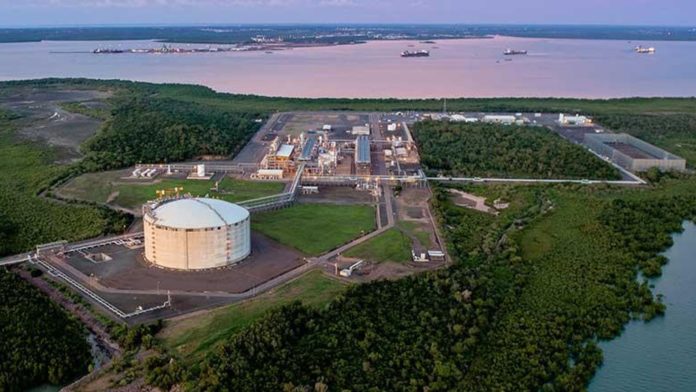
The Northern Territory Government has made a significant step towards developing the Middle Arm Sustainable Development Precinct as a new renewable energy, investment, and jobs powerhouse.
The precinct, powered by renewable and low-emissions energy, is being created to attract sectors that reflect the Territory’s future economy, such as hydrogen, carbon capture, natural gas, advanced manufacturing, and minerals processing.
“Middle Arm is about building the Territory’s future. This is about new sources of renewable and low-emissions energy, new investment, new industries, and most importantly, new jobs for Territorians,” Chief Minister Natasha Fyles said.
“We’re absolutely committed to growing our economy while also transitioning to net zero emissions, and Middle Arm will play a huge part in that transition. This is what responsibly decarbonising and diversifying our economy looks like,” Chief Minister Fyles stated.
The State Government has granted ‘not to deal’ commitments to five proponents over particular parcels of land within the precinct to provide interested companies security as they build projects at Middle Arm.
These commitments indicate that their preferred Middle Arm locations will be reserved for up to 12 months, giving each proponent confidence and assurance to continue developing their plans. Proponents include:
- TEH2, 100% owned by Total Eren – renewable energy; Total Eren proposes to build a solar-powered green hydrogen production facility capable of producing more than 80,000 tonnes of renewable-based hydrogen per year for domestic and international markets.
- Fortescue Future Industries (FFI) – renewable energy; FFI proposes building a green hydrogen hub, including green hydrogen and ammonia production and export facilities.
- Tivan – critical minerals; Tivan proposes to manufacture vanadium oxides utilising new downstream processing technologies and feedstock obtained from Tivan’s Speewah and Mount Peake projects, with titanium dioxide and iron oxide generated as byproducts. Tivan also strives to create a path to industrialisation for vanadium redox flow batteries.
- Tamboran Resources Limited – natural gas; a liquefied natural gas (LNG) export plant with lower CO2 emissions. Gas from this export plant will be critical to the decarbonisation goals of neighbouring countries and trading partners in Asia and beyond
- Avenira – critical minerals; Avenira proposes a lithium-ferrophosphate (LFP) cathode production plant to produce precursor battery cathode materials from critical minerals such as phosphate from the Wonarah Project in the Northern Territory.
According to the State Government, these projects represent tens of billions of dollars in capital investment, with the overall Middle Arm development generating around 20,000 jobs in the Territory.
The companies will now move forward with their facility designs, engineering work, pre-feasibility studies, and environmental permits. They will be expected to comply with any requirements imposed by the NT EPA as part of the precinct’s Strategic Environmental Assessment, which is now underway.
“We’ve always said that sustainability will be at the core of Middle Arm, and our focus on clean energy demonstrates that. An environmental strategic assessment is underway now for the entire precinct,” Chief Minister Fyles added.
The State Government said the Northern Territory is poised to be a worldwide leader in low-emissions energy export and critical minerals processing, capitalising on its world-class solar and energy resources and meeting significant international market demand to aid in the global energy transition.
The Government added that Middle Arm is generating a lot of interest since it will enable the establishment of an interconnected hydrogen sector and use carbon capture to boost low-emission industrial growth.
As part of the Middle Arm Sustainable Development Precinct, a Carbon Capture Utilisation and Storage Hub will be built to reduce emissions from present and future natural gas processing and to accelerate low-emission sector growth, including hydrogen generation.