
ANSTO’s Australian Synchrotron has been awarded an Australian Research Council (ARC) Linkage Project funding for research on an improved battery system for stationary energy storage.
The University of Queensland (UQ) researchers are developing water-based iron flow batteries in collaboration with industry partner Energy Storage Industries Asia Pacific. They employ non-toxic iron chloride as the electrolyte and are rechargeable and suited for large grid-scale storage.
According to ANSTO, they have the potential to provide clean, dependable, and cost-effective long-duration energy.
Iron (III) chloride is converted to iron (II) chloride at the positive electrode during the discharge of an iron flow battery. The metallic iron disintegrates into the electrolyte as iron (II) chloride at the negative electrode. When a battery is being charged, the processes are reversed.
ARC Fellow and Group leader at the Australian Institute for Bioengineering and Nanotechnology (UQ) Dr Bin Luo, Prof Ian Gentile of School of Chemistry and Molecular Biosciences (UQ) and Research fellow Dr Masud Rana of UQ will keep working to remove the main impediment to widespread commercial deployment. A competitive side reaction that takes place at the negative electrode during battery charging results in a low round-trip energy efficiency.
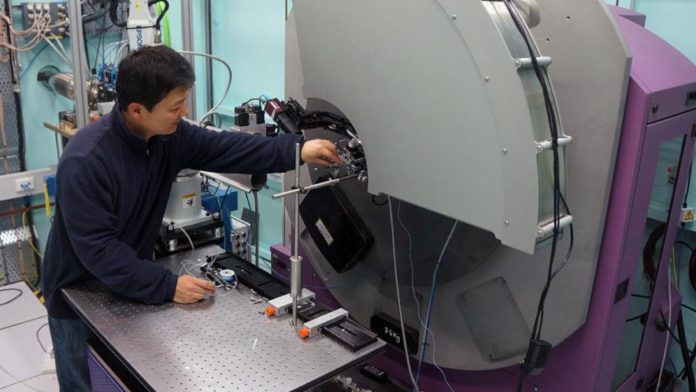
Principal beamline scientist at the Australian Synchrotron and a partner investigator Dr Qinfen Gu will support the research by assisting with experimental design, operando set-up development, flow battery testing, and data analysis utilising the Powder Diffraction beamline.
“The powder diffraction beamline is useful in determining how structural modifications impact function. The performance of innovative new materials can also be tested on an operating battery at the Australian Synchrotron, where we support a great range of battery research,” Dr Gu said.
The research will address the system’s low energy efficiency by improving battery performance and lowering costs by designing the negative electrode-electrolyte interface using functional materials.
The project aims to design iron electrodes with functional interface layers, to demonstrate iron flow battery technology at the lab scale, to conduct a pilot-scale test of the technology for commercial applications, and to understand the effect of the functional interface layer on the iron plating process and battery performance.
The team plans to use the linkage grant funding to develop new materials and processes for advanced battery technology and Australian manufacturing and contribute to the national aim of achieving net-zero carbon emissions by 2050.