
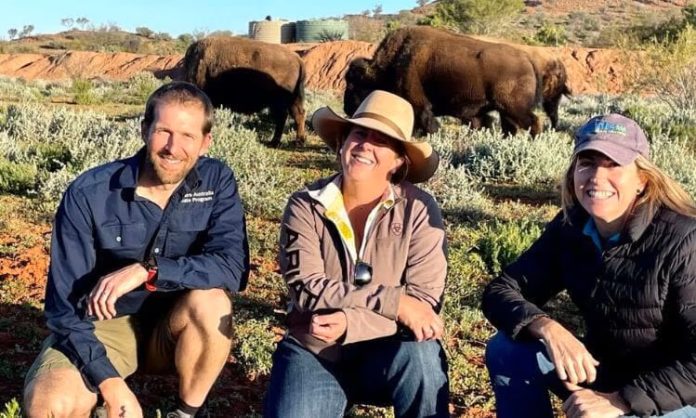
The Northern Australia Climate Program (NACP), a joint effort by the University of Southern Queensland (UniSQ) and the Bureau of Meteorology (BoM), conducted a two-week BoM to the Bush Roadshow in Central Australia to educate cattle producers.
According to NACP Climate Project Officer Northern Territory (Central & Barkly Region) Zoe Groves, the purpose of BoM to the Bush was to demystify the Bureau’s climate forecasts for cattle producers so they could have all the data before making a decision.
“Our main aim was to engage with producers on the ground to make sure they’re making management decisions based on the forecasts and making sure they know how to read and interpret all the data,” Groves said.
“It’s about restoring that faith and trust in what the Bureau produces, and actually meeting someone with a face and a name,” she continued.
Groves was accompanied on the BoM to the Bush Roadshow by UniSQ Dr Andrew Marshall and NACP Climate Project Officer Northern Territory (Top End & Victoria River regions) Emily Hinds.
Hinds stated that the face-to-face aspect of the roadshow was especially crucial in light of the 2019 drought, which damaged numerous properties and had long-term consequences.
“Perception change is so important; when you can meet someone in person who can explain the process of forecasting, it goes a long way to developing a relationship and encouraging a respectful and positive appreciation of the Bureau of Meteorology’s work and the forecasts themselves,” she said.
“And it’s a two-way street – we also find the Bureau of Meteorology staff develop an appreciation of the work that producers do, because they can see firsthand the huge importance that a relevant and accurate forecast can provide in terms of decision-making on properties, she added.
According to Dr Marshall, one of the most significant variables in effectively evaluating the Bureau’s estimates was simply recognising how much such forecasts could change as producers approached a given time period.
“When a producer is looking at the forecast for a few months ahead, it’s really important they keep coming back to that forecast as they get closer to that time, because it can change,” Dr Marshall said.
“There are several influences on climate and how those influences occur on different time scales, and so being able to communicate that was one of the key objectives,” Dr Marshall added.
The BoM to the Bush Roadshow to Central Australia was the ninth of its kind in the NACP program’s history.
The NACP program is led by UniSQ’s Centre for Applied Climate Sciences in partnership with the BoM, the UK Met Office, the Queensland, Northern Territory, and Western Australian Departments of Agriculture, and four Natural Resource Management groups.
The NACP is funded by the UniSQ, the Queensland Government‘s Drought and Climate Adaptation program, and Meat and Livestock Australia.