
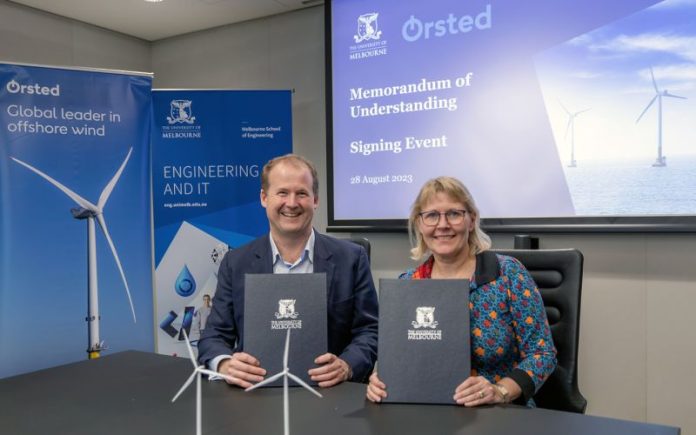
The University of Melbourne‘s Faculty of Engineering and Information (FEIT) has collaborated with offshore wind developer Orsted to support Australia’s shift to renewable energy through advanced research capabilities.
FEIT Dean Professor Mark Cassidy signed a Memorandum of Understanding (MOU) with Orsted, a company with over 30 years of experience in offshore wind energy projects across Europe, America, and Asia-Pacific.
The MOU will combine Orsted’s unique operating experience with the University’s extensive knowledge of the local marine environment, biodiversity, and Indigenous Sea Country to assist in designing and delivering the finest offshore wind results in Australia.
The collaboration will focus on improving the preparedness of students and researchers for careers in the growing renewable energy sector, in addition to developing academic and research cooperation within the offshore wind sector.
“This MOU with Orsted will allow us to play a pivotal role in unlocking the potential of offshore wind energy, with long-term benefits for local communities, the economy and the overall environment,” Professor Cassidy said.
Orsted Australia Director Henriette Holm stated that the collaboration will utilise the skills of two global experts in their respective disciplines who are committed to Australia’s offshore wind and renewable energy future.
“With the sharing of expert local and global knowledge, the MOU will help accelerate collaboration around offshore wind opportunities to deliver the best outcomes for Australian communities, workforces, educators, businesses and the environment,” Holm said.
“Orsted is a strong believer in long-term academic partnerships, which have helped it achieve unrivalled success in constructing 33 offshore wind farms across Europe, the US and Asia Pacific,” Holm added.
Orsted believes that the growth of the Australian offshore wind industry has enormous potential for both established professionals with transferrable skills and those just entering the workforce. The first phase of Orsted’s proposed project off the coast of Gippsland in Victoria will generate up to 6,000 jobs, with local employees and students able to benefit from technical knowledge and skills transfer programs.
University of Melbourne lead Dr Shiaohuey Chow stated that the university is well-positioned to provide access to and focused development of a dedicated workforce.
“I am excited to work together with Orsted to contribute towards unlocking offshore wind energy in Australia. Extending beyond workforce development, our research capabilities at the University of Melbourne will support Ørsted to tackle challenges unique to the Australian development of offshore wind farms,” Dr Chow said.
The partnership will begin with a guest lecture on offshore wind foundation design provided by Orsted Senior Specialist Avi Shonberg in a newly established subject titled “Offshore Wind Geotechnical Engineering.”