
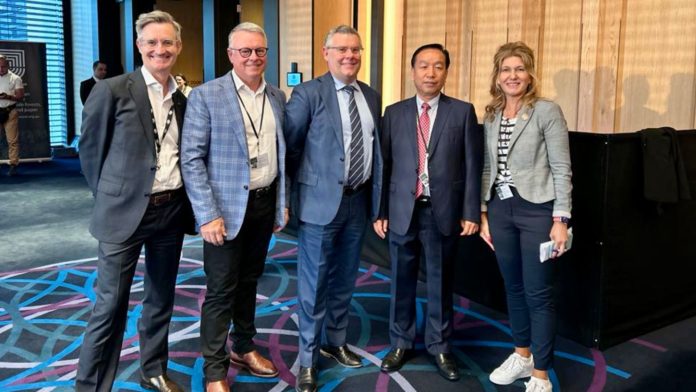
Minister for Forestry Murray Watt has highlighted the crucial role of Australia’s sustainable forestry management, including regrowth native forests and plantations, in addressing climate change and promoting green construction and the emerging bio-circular economy during a speech at the Asia-Pacific Forestry Commission (APFC) Marketplace, co-hosted by the Australian Forest Products Association (AFPA).
“AFPA partnered with the Australian Government to co-host a Marketplace event which provided delegates from across the Asia-Pacific region an opportunity to network and engage with Australia’s industry representatives at the 30th APFC Session – fittingly themed Sustainable Forests for a Sustainable Future. AFPA thanks Minister Watt for his involvement at the Marketplace and continued strong support for Australia’s sustainable forestry and forest products sector,” Acting AFPA Chief Executive Officer Natasa Sikman said.
During his address, Minister Watt underscored the sequestration power of Australia’s sustainably managed forests.
“Australia has a total of 134 million hectares of forests with 87 percent of that harvested from softwood and hardwood plantation estates. Our native forests continue to play an important role in meeting our nation’s timber needs, as well as supporting our carbon sequestration aims,” Minister Watt said.
“Australia’s National Greenhouse Gas Inventory reported that overall production of native forests contributed a net carbon sink of 39 million tonnes of carbon dioxide equivalent in 2020, with sequestration from regrowth exceeding emissions from harvesting.”
Sikman expressed gratitude to Minister Watt for acknowledging the crucial science supported by the UN’s Intergovernmental Panel on Climate Change (IPCC).
“A sustainable forest management strategy aimed at maintaining or increasing forest carbon stocks, while producing an annual sustained yield of timber, fibre or energy from the forest, will generate the largest sustained mitigation benefit – IPCC 4th Assessment,” the Minister stated.
Minister Watt cited the potential of sustainable forestry for green construction and the growing bio-circular economy as grounds for Australia’s pioneering participation in the Forests and Climate Leaders Partnership.
“Australia’s sustainably managed native and plantation forestry and the products that Australians love to use every day are an important part of the solution for Australia to meet its net-zero climate goals. We are already seeing the positive impact of transitioning to a low carbon circular bioeconomy, from mass timber buildings reducing emissions by up to 40 per cent, to displacing harmful plastics are playing in Australia’s society. But to have a greater impact, collectively governments and industry need to do more, and this was a key point made by conference delegates,” Sikman said.
“AFPA on behalf of our Sector and the wonderful people who work across the entire supply chain we thank Minister Watt for his support at this week’s APFC and continued support for Australia’s forest products sector,” Sikman added.