

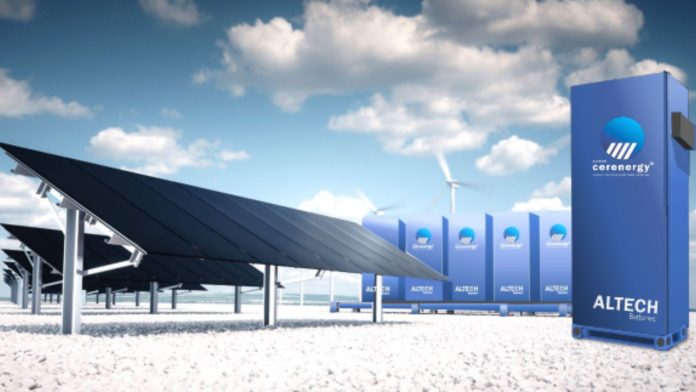
Altech Chemicals Limited has announced it has designed and released the CERENERGY® Sodium Alumina Solid State (SAS) 60 KWh battery pack (ABS60).
In a statement, Altech said CERENERGY® is designed for the renewable energy and grid storage markets as part of its battery joint venture with Fraunhofer.
Based on initial negotiations with possible off-takers for the 100MWh CERENERGY® battery project, the proposed 10 KWh battery module has been replaced by a 60 kWh battery pack (ABS60) rated at a higher voltage of 620 volts and 100 amp hour (Ah).
Altech signed a joint venture (JV) agreement with world-leading German battery institute Fraunhofer IKTS on 14 September 2022 to commercialise Fraunhofer’s breakthrough CERENERGY® Sodium Alumina Solid State (SAS) Battery. Altech, along with Altech Advanced Material AG, will hold 75 per cent of the JV business, commercialising a 100 MWh project to be built on Altech’s land in Schwarze Pumpe, Germany.
According to Altech, CERENERGY® batteries are a significant changer in grid storage, replacing lithium-ion batteries. Altech said CERENERGY® batteries are fire and explosion resistant, have a life expectancy of over 15 years, and can be used in extreme cold and desert situations. The battery technology is lithium-free, cobalt-free, graphite-free, and copper-free, which eliminates exposure to essential metal price increases and supply chain problems. On Altech’s facility in Saxony, Germany, the Altech-Fraunhofer joint venture is developing a 100 MWh SAS battery plant (Train 1), specifically focusing on the grid (stationary) energy storage sector.
The ABS60 battery pack will comprise 240 CERENERGY® cells (each rated at 2.5 V), organised in four rows of 12 cells and five cell modules high. The packs are designed to meet the Ingress Protection (IP) 65 standard (levels of electrical enclosure sealing effectiveness), which implies they will be dust and waterproof. According to Altech, the battery pack will be perfect for chilly European areas because the CERENERGY® batteries can function at an extensive temperature range, minus (-) 40 deg C to plus (+) 60 deg C.
Altech said the larger ABS60 battery pack allows more efficient installation in renewable energy storage and grid storage applications. The larger packs will lower the price of module assembly casing and joining. Using one Battery Management System (BMS) processor instead of six BMS processors for the previously anticipated separate 10 KWh modules saves money. For a larger 60 KWh battery, the fuse and disconnectors will be reduced by the same factor.
The battery factory will now be built to produce ABS60 battery packs as a standard product to suit Europe’s renewable energy and grid storage markets. Fraunhofer previously projected that the cost of creating CERENERGY® batteries should be around 40 per cent less than lithium-ion batteries, owing to the lack of the need for lithium, graphite, copper, or cobalt. This will be verified in Altech’s Bankable Feasibility Study, which is presently underway.
According to a new report, renewable energy sources were employed to fulfil rising worldwide electricity demand in the first half of 2022. Forecast reports also show that the grid storage industry would increase at a 28 per cent CAGR over the next two decades. The global market for battery energy storage systems is predicted to increase from USD 4.4 billion in 2022 to USD 15.1 billion by 2027. Alternatively, growth is predicted to increase from 20 GW in 2020 to over 3,000 GW by 2050. SAS batteries can provide excellent security at cheap acquisition and operating costs for the stationary energy storage industry.
Combining wind and solar with battery storage has numerous benefits, according to Altech. The Wheatridge Renewable Energy Project in Oregon is an example of how integrating renewable energy sources with battery storage can help supply reliable, sustainable energy as utility companies seek to cut carbon emissions. Large battery systems are constructed near solar and wind farms in these applications. Utilities have used lithium-ion batteries to store renewable energy after the sun goes down or the wind stops blowing. Existing utility-scale storage, however, can only discharge energy for up to four hours at a time, implying that systems cannot offer broad electricity for an extended length of time. There is a demand for medium and long-duration batteries that can offer continuous power for extended periods.
Altech’s CERENERGY® ABS60 battery packs are intended to address this void. The newly developed Altech ABS60 battery packs are projected to charge and discharge in about 6 hours. They can discharge in less than 3 hours if necessary. Next, the Altech design team will work on optimising heat transfer modelling and insulation design.





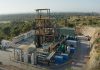




 60 KWh battery pack (ABS60).)