
The Australian Nuclear Science and Technology Organisation (ANSTO) has welcomed $13.9 million in funding under the Australian Government’s Australian Critical Minerals Research and Development Hub.
The funding will be used towards a research project to boost the discovery, extraction, and processing of rare earth elements from clay-hosted and ionic adsorption rare earth deposits.
Minister for Resources and Northern Australia Madeleine King unveiled the $22 million package supporting three key research projects conducted by ANSTO, CSIRO, and Geoscience Australia.
ANSTO CEO Shaun Jenkinson said ANSTO Mineral’s expertise in rare earth elements will significantly enhance the potential of lower-grade Australian deposits.
“Australia already has a rich supply of high-grade rare earths deposits and strong expertise in processing techniques to extract the most out of our resources, that puts us in a strong position globally,” Jenkinson stated.
“This funding will allow us to gain an even greater understanding of the mineralogy and processing routes needed to tap into clay-hosted and ionic adsorption deposits, which have higher ratios of sought after magnet metals.”
ANSTO, in collaboration with Geoscience Australia and CSIRO, will undertake a two-year project to:
- assess Australia’s potential for clay-hosted and ionic adsorption of rare earth element deposits,
- develop and test mineral processing options tailored to particular resources,
- showcase how these deposits can be integrated into existing rare earth element separation processes to produce high-purity rare earth elements,
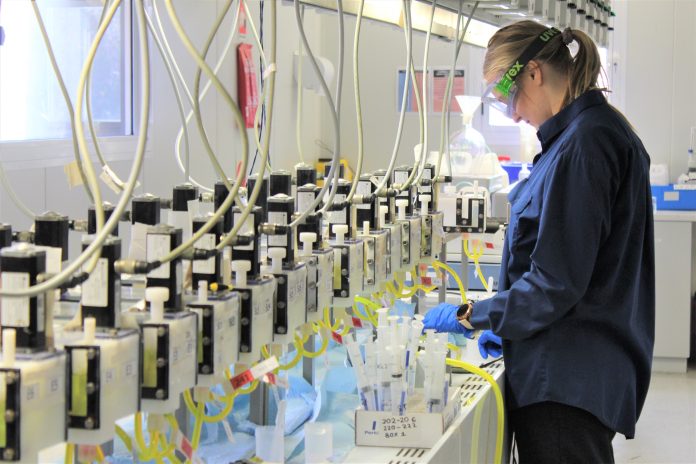
- establish a specialised testing facility at ANSTO, and
- improve the environmental impact of critical minerals mining and processing.
Additionally, as stated by Minister King, ANSTO will also provide to each of the separately funded initiatives led by the CSIRO and Geoscience Australia. ANSTO will contribute to:
- CSIRO’s $5.2 million metallisation project, to acquire a technical understanding of the conversion of tungsten mineral concentrates to high value-added chemical concentrates and tungsten oxides, and
- Geoscience Australia’s $2.7 million research project, to investigate the technical recovery of gallium from bauxite refining process liquors and examine how current bauxite refineries can provide prospects for Australia.
Jenkinson emphasised that critical minerals and rare earths are vital components in essential technologies like personal electronic devices, transport, and telecommunications.
“Critical and strategic minerals such as rare earths, uranium, and lithium already form a large part of ANSTO’s Minerals business. The recent shift in focus towards diversifying and securing their supply chains is an exciting re-direction to unlocking Australia’s critical minerals resources and supporting our commitment to net zero,” Jenkinson stated.
“ANSTO is looking forward to continuing this invaluable work with our R&D Hub partners — Geoscience Australia, and CSIRO — and the Critical Minerals Office at the Department of Industry, Science and Resources.”
The R&D Hub, established in October 2022, combines Australia’s top science agencies’ expertise with industry, universities, and research to tackle technical issues and drive collaborative research across the critical minerals value chain, supporting clean energy and Australia’s net zero policy agenda.
The R&D Hub is overseeing seven funded research projects, including ANSTO’s High Purity Quartz (HPQ) project, which aims to develop sovereign processing capabilities for Australian producers.