
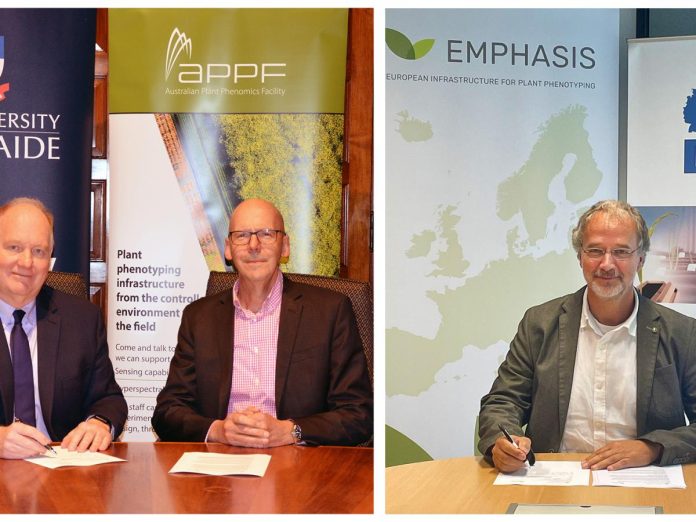
The University of Adelaide and Forschungszentrum Jülich have signed a Memorandum of Understanding (MOU) to address global challenges in crop productivity and food security.
The MOU outlines a partnership between international researchers at the University of Adelaide’s Australian Plant Phenomics Facility (APPF) and the European Infrastructure for Plant Phenotyping (EMPHASIS) in Germany coordinated at Forschungszentrum Jülich in Germany, aimed at enhancing crop improvement.
According to the University of Adelaide, plant phenotyping is a rapidly expanding field of plant science that utilises data collected through point sensors, imaging systems, and remote sensing platforms to efficiently validate new traits and environmental dynamics.
The APPF and EMPHASIS are world-leading infrastructure facilities that help researchers understand plant structure and function, accelerating the development of resilient and higher-yielding crops. Closer collaboration between these organisations will lead to increased research efficiencies, shared technical innovations, project cooperation, and avoiding duplication.
The Australian Government‘s National Collaborative Research Infrastructure Strategy (NCRIS) supports the APPF, which the University of Adelaide hosts.
“Sharing knowledge is fundamental to progressing innovation in plant phenomics and this MOU has been drafted by both parties to establish the framework within which our cooperation can be developed,” University of Adelaide Deputy Vice Chancellor and Vice President (Research) Professor Anton Middelberg said.
“The agreement also establishes joint principles for collaboration and agreed sets of standards that will benefit the plant science and plant phenotyping communities in Europe and Australia. It will broaden the scope of our research and create joint opportunities for education and outreach, project funding, and sharing phenotyping information that advances plant science at the University,” Professor Middelberg stated.
APFP Chief Executive Officer Richard Dickmann commented, “The agreement recognises the world-class capabilities of the APPF and will have benefits for Australian farmers, regional communities and people choosing a career linked to agricultural research. We are now establishing a working committee to implement our pathway forwards.”
EMPHASIS coordinator Research Centre Jülich Professor Ulrich Schurr said Australia and Europe have collaborated to advance modern plant phenotyping over the past decade.
“We are excited to further extend this very successful cooperation and strengthen the connection between plant phenotyping researchers from APPF with the European plant phenotyping community organised by EMPHASIS,” he said.
Dr Inmaculada Figueroa, Vice Chair of the European Strategy Forum on Research Infrastructures, expressed positive sentiments about the new MOU.
“International cooperation in science and technology linking research infrastructures is an important part of addressing major global challenges such climate change, sustainable agriculture and food security,” Dr Figueroa said.
“The cooperation between APPF and EMPHASIS represents an important step to jointly and synergistically address these global challenges.”