
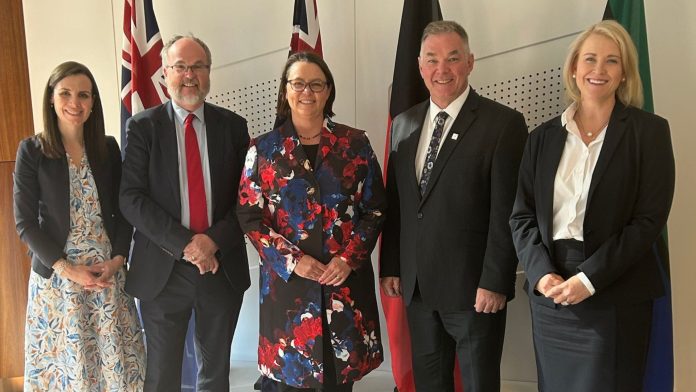
Following a roundtable in Brisbane, federal, state, and territory ministers for resources and mining reiterated support for Australia’s critical minerals industry and reaffirmed a commitment to attract foreign investment for resource projects.
The discussion took place on the sidelines of the World Mining Congress, which gathered mining executives, investors, and decision-makers from all over the world to Brisbane.
Minister for Resources and Northern Australia Madeleine King used the ministerial roundtable to update state and territory ministers on the new Australian Critical Minerals Strategy, which lays out a vision for developing the sector and downstream processing of critical minerals, as well as strengthening international partnerships and supply chains.
“The Australian Government is committed to working with the states and territories to boost the development of our critical minerals sector and create new jobs in processing those minerals into materials that are crucial for the clean energy future,” Minister King said.
According to Minister King, the Strategy outlines a strategy for Australia to become a globally major producer of raw and processed critical minerals while also increasing economic possibilities for First Nations people and regional communities.
“Through the Resources Ministers’ Roundtable, we are working to build a common understanding of how Governments can maximise these opportunities for the benefit of all Australians,” Minister King stated.
The Ministers also examined the Future Gas Strategy for Australia. The Federal Government noted that state and territory governments will play a significant role in creating the Strategy, which will clarify the future role of gas in supporting Australia’s energy system’s goal of reaching 82% renewables by 2030, as well as ensuring the energy security of our main trading partners.
Minister King spoke at a special symposium of the World Mining Congress, saying that the worldwide move to clean energy and lower emissions will necessitate more mining to fulfil the demand for low-emissions technologies.
She referenced the recent International Energy Agency analysis, saying the world will require about 50 new lithium mines, 60 new nickel mines, and 17 new cobalt mines by 2030 to reach emission targets for that year.
Minister King stated that mining and downstream processing companies also needed to do more to minimise emissions and lessen their negative effects on the environment and biodiversity.
“With the world on the cusp of an energy transformation, these are exciting times for the global mining sector. There are vast opportunities ahead for Australia in this transformation,” Minister King said.
“Fully realising them, however, will involve mining companies embracing new responsibilities and obligations. These include a commitment to enhancing our environmental and social governance credentials and serious pledges to reduce carbon emissions at source and downstream,” Minister King added.