
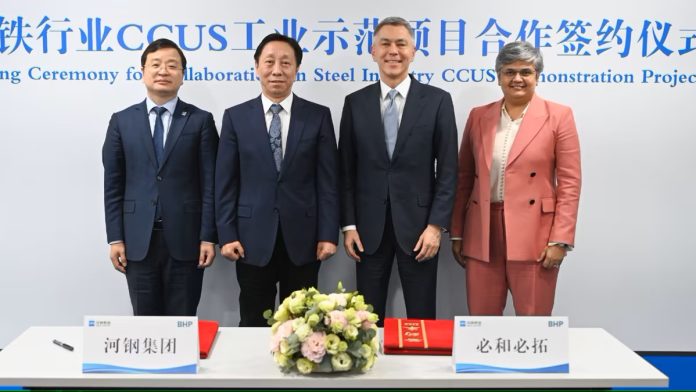
BHP has inked an agreement with China’s HBIS Group Co., Ltd (HBIS) to trial carbon capture and utilisation technology.
HBIS and BHP will conduct pilot-scale demonstrations of carbon capture and utilisation technology at HBIS’ steel operations in China as part of the new initiative. The project will develop and evaluate CO2 reduction methods that may be integrated into steel production processes. These include Vacuum Pressure Swing Adsorption (VPSA), an alternative carbon capture technology, and two CO2-use technologies (slag mineralisation and biological conversion to protein).
Furthermore, BHP will assist HBIS in developing and deploying absorptive desulfurisation at the HBIS ZXHT Hydrogen Metallurgy Demonstration Project in Xuanhua, Hebei, to allow the use of 60,000 tonnes per year of captured CO2 from the Direct Reduced Iron process in the food or industrial sectors.
“Our multi-faceted partnership with HBIS will now include pilot testing of novel carbon capture technology at their operating sites in Hebei, and builds on the separate carbon capture trial with ArcelorMittal, Mitsubishi Heavy Industry and Mitsubishi Development, announced in October 2022. Hebei province accounts for around 20 per cent of China’s reported steel production and represents one of the locations in which we aim to support future carbon capture, utilisation and storage initiatives. With our support, HBIS will also be pilot testing options for the utilisation of captured carbon dioxide for the production of saleable products and sequestration in waste slag,” BJP Chief Commercial Officer Vandita Pant said.
According to BHP, the new agreement builds on the work streams envisioned in the Memorandum of Understanding (MoU) signed in 2021 by BHP and HBIS and the Phase 1 research and development work announced in 2022 with HBIS and the University of Science and Technology Beijing. BHP has also assisted HBIS in Improved Lump experiments, which aim to develop techniques for improving direct feed iron ore lump utilisation to achieve incremental reductions in carbon dioxide emissions intensity of steel production at one of the steelmaker’s plants in Hebei province as part of the MoU.
“This collaboration between BHP and HBIS, a leader in the global steel industry and an important customer for our iron ore, will provide a strong example for the industry to follow towards the wider deployment of CCUS and towards achieving major reductions in the CO2 emission intensity of steel production. This joint program demonstrates a strengthening of our partnership, as we progress ambitions established in our 2021 MoU and shows a willingness of the parties to advance innovative technologies that are fit for purpose for steel,” BHP Chief Executive Officer Mike Henry stated.
BHP’s most recent partnership agreement with HBIS will leverage an investment of up to US$15 million over three years envisaged by BHP and HBIS in the MoU inked in 2021.
“BHP is a globally renowned resource company and a long-term partner with HBIS with shared goals in relation to the development of technologies to abate carbon emissions in the steel-making sector. The signing of these projects is another milestone since the two parties’ ‘Memorandum of Understanding for Strategic Collaboration in Climate Change’ signed in 2021, it starts a new journey in jointly exploring CCUS technology developments in the steel sector,” HBIS Chairman Yu Yong said.
Chairman Yu added, “HBIS is committed to being a leader, explorer, and practitioner in the industry’s transition to lower carbon emissions. CCUS has been identified as a breakthrough technology for reducing carbon emissions from steel and this has anchored CCUS technology as a key component in HBIS Group’s low-carbon technology roadmap. In the future, HBIS will continue to focus on the goal of jointly addressing climate change, deepening cooperation with industry value chain partners, adhering to the concept of sustainable development, and consistently cultivating and investing in the green and low-carbon field.”