
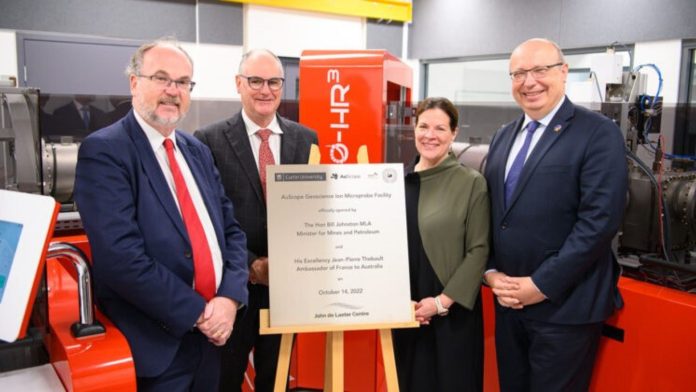
Mines and Petroleum Minister Bill Johnston welcomed the first CAMECA 1300-HR3 ion microprobe in the Southern Hemisphere launched at Curtin University.
Curtin University is home to a new cutting-edge equipment that will provide researchers and industry with access to world-class microanalytical infrastructure to aid in discovering the next generation of critical mineral resources and unravelling the universe’s secrets.
Minister Johnston said establishing Australia’s first geoscience ion microprobe station marks an exciting new milestone in the longstanding partnership between the McGowan Government and Curtin University.
“It’s particularly pleasing to know the research here will help underpin the future success of resource exploration and development in Western Australia. Continuing to grow our mineral and petroleum industries is vital to supporting our communities, creating jobs and transitioning to low carbon future,” the Minister stated.
According to Minister Johnston, Western Australia’s resources sector is already a global leader in technology and research; access to the ion microprobe will give the State a distinctive technological advantage in discovering the upcoming resource generation.
The new AuScope Geoscience Ion Microprobe Facility, unveiled by the French Ambassador to Australia H.E. Jean-Pierre Thébault and Minister Johnston, is centred around the French-built CAMECA 1300-HR3 secondary ion mass spectrometry instrument, one of only five such installations in the world.
The $10.7 million research initiative has received $3.2 million from the Western Australian Government. The project will be housed in a new National Collaborative Research Infrastructure Strategy (NCRIS) Flagship Facility at Curtin University’s John de Laeter Research Centre.
Additionally, it will help researchers working with the Australian Space Agency to analyse asteroid fragments and meteorites found in the Australian outback.
Curtin University Vice-Chancellor Professor Harlene Hayne said to keep Curtin at the front edge of science, the new AuScope Geoscience Ion Microprobe will support significant research, government, academic, and industry collaborations.
“This new instrument will be used by Earth scientists to determine the composition and evolution of the Australian continent, mineral deposits and surface materials, and will support space scientists to analyse meteorites discovered in the Australian outback and asteroid fragments recovered during international deep space missions,” Professor Hayne stated.
Professor Hayne added that researchers from the Curtin Space Science and Technology Centre would use the new equipment to examine uncommon and distinctive asteroid samples returned to Earth via the Hayabusa2 and Osiris-Rex deep-space missions.
According to Curtin University’s Director of the John de Laeter Centre, Professor Brent McInnes, the Sensitive High-Resolution Ion Microprobe (SHRIMP) will be replaced with the new CAMECA equipment.
“The previous SHRIMP instrument played an important role in many successful geoscience and planetary science research projects at Curtin, including the discovery of the oldest minerals on the Earth, Moon and Mars. We are so excited to see what discoveries we can achieve next,” Professor McInnes said.
The Western Australian Government has also committed to supporting the nomination of Professor Axel Schmitt, a known authority on isotope geochemistry, to lead the new institution through the Geological Survey of Western Australia.
The National Collaborative Research Infrastructure Strategy (NCRIS) Program (via AuScope), the WA Department of Mines, Industry, Regulation and Safety (via Geological Survey of WA), the Australian Department of Education, Skills and Employment, and Curtin University all provided funding for the research infrastructure project.