

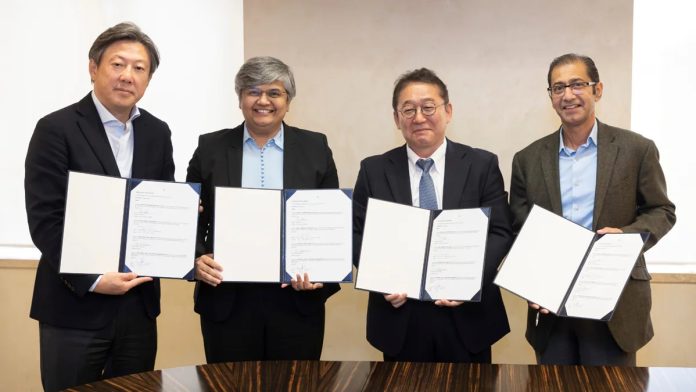
Following the inking of a finance agreement between the parties, ArcelorMittal, Mitsubishi Heavy Industries Engineering (MHIENG), BHP, and Mitsubishi Development Pty Ltd are working on a multi-year study of MHIENG’s carbon capture technology with ArcelorMittal.
In addition, the companies will undertake a feasibility and design study to enable the transition to full-scale deployment.
The agreement brings together the different partners’ skills to improve carbon capture and utilisation and/or storage (CCUS) technologies in the difficult-to-abate steelmaking industry. It involves a trial at ArcelorMittal’s steel plant in Gent, Belgium, and another site in North America.
According to estimates, the sector is responsible for seven to nine per cent of the world’s greenhouse gas (GHG) emissions. Since current worldwide blast furnaces are expected to continue producing a sizable amount of the world’s steel over the following decades, CCUS has the potential to be an essential technology for reducing emissions from these furnaces. For the Net Zero Emissions scenario, the IEA calculates that CCUS technology must be used for more than 53 per cent of primary steel production by 2050, or 700 Mtpa of CO2.
Only a few small-scale carbon capture or utilisation pilot projects are currently underway or internationally planning. There are no full-scale operating CCUS facilities in blast furnace steelmaking plants. But later this year, ArcelorMittal Gent will operate its Steelanol project, a demonstration facility of a smaller size that will absorb carbon-rich blast furnace process gases and turn them into ethanol.
ArcelorMittal is facilitating the trial at its five million-tonne-a-year steel plant in Gent, Belgium, and another location in North America, with MHIENG supplying its proprietary technology and supporting the engineering studies. This is being done to better understand how carbon capture technology can be integrated into existing steel plants.
The trial will be funded by BHP and Mitsubishi Development, two important suppliers of high-quality steelmaking raw materials to ArcelorMittal’s European facilities. The study in Gent will include two phases. Due to the varying quantities of pollutants in the top gas, the first phase entails isolating and extracting the CO2 top gas from the blast furnace at a rate of about 300 kg per day. The hot strip mill reheating furnace, which burns various industrial gases comprising coke gas, blast furnace gases, and natural gas, is used in the second phase to evaluate the separation and capture of CO2 from the offgases.
To evaluate MHIENG’s technology in this steelmaking process, the parties intend to place the mobile test unit in one of ArcelorMittal’s North American Direct Reduced Iron (DRI) plants.
“The decarbonization of the steel industry is a huge challenge that we cannot solve alone: it is through pan-industry partnerships and collaboration that we will achieve ArcelorMittal’s climate goals of reducing CO2 emissions by 35 per cent by 2030 in Europe, and by 30 per cent by 2030 worldwide. Alongside our continued energy efficiency improvements, we are developing two routes to decarbonize steelmaking: Smart Carbon and Innovative-DRI. Both routes will contribute in our journey to deliver carbon-neutral steelmaking. The Smart Carbon route also allows us to integrate carbon capture and re-use (CCU) or storage (CCS) technologies, capturing carbon emitted during the steelmaking process. We are therefore proud to be working with BHP, Mitsubishi Development and Mitsubishi Heavy Industries Engineering on this pioneering Carbon Capturing pilot project, in ArcelorMittal Gent,” ArcelorMittal Belgium’s Chief Executive Officer Manfred Van Vlierberghe said.
About two-thirds of the overall capital cost and the majority of additional energy are consumed by carbon capture activities, which are the most expensive part of the CCUS value chain. To assess carbon capture technology’s contribution to efforts to decarbonise the steel sector, a better understanding of its performance, cost, risk, and sustainability results is necessary.
This most recent partnership, which follows partnerships in recent years with other global majors POSCO, China Baowu, JFE Steel, HBIS Group, and TATA Steel, represents a significant turning point in BHP’s strategy to support decarbonisation efforts in the steelmaking industry. This strategy aims to achieve coverage of geographically diverse customer markets and potential technology pathways. Together with ArcelorMittal, these businesses produce more than 17 per cent of the steel reportedly produced worldwide.
“There is currently no certain or single pathway to net zero for steelmaking. CCUS is one of the key abatement technologies with potential to support development of some of those pathways, so working with industry leaders like ArcelorMittal, Mitsubishi Development and MHIENG, we hope to arrive at scalable solutions more quickly to help reduce carbon emissions in steelmaking,” BHP Chief Commercial Officer Vandita Pant said.
Pant highlighted the need to put a lot of effort into enabling lower GHG emissions in steel, assisting the decrease of carbon intensity in the blast furnace, and testing innovative technologies for steel production because steel is a crucial product for the world to develop and decarbonise.
Mitsubishi Development’s Managing Director and Chief Executive Officer Sadahiko Haneji stated that the business would continue to fulfil its obligation as an active player in relevant industries to contribute to the achievement of a carbon-neutral society.
“Mitsubishi Development recognizes that as an industry we have to collaborate to establish carbon capture trials that can be used as a steppingstone to progress technological advancement and build the industry’s confidence to reduce carbon emissions,” Heneji said.
He added that participating in these trials shows its commitment to developing climate technologies and decreasing our carbon footprint in methods that do not jeopardise our quality of life.
MHIENG has been developing its unique KM CDR ProcessTM for CO2 capture in partnership with Kansai Electric Power since 1990, and as of October 2022, it has deployed 14 plants internationally, with two more under development.
MHIENG’s President and Chief Executive Officer Kenji Terasawa said: “The steel sector, as a major emitter of CO2, is still a new frontier for CCUS. Deploying our proven technology quickly and at scale could contribute to curbing emissions in the near term, while new technologies for low-carbon steelmaking are brought to market and scaled up. We, as an innovative solutions provider, are excited to work with ArcelorMittal, BHP and Mitsubishi Development to accelerate the industry’s efforts to reach net zero by 2050.”






, BHP, and Mitsubishi Development Pty Ltd are working on a multi-year study of MHIENG's carbon capture technology with ArcelorMittal. )