
A study found that the diet quality of fish in vast portions of the world’s oceans might fall by up to 10% as climate change influences a vital component of marine food chains.
QUT School of Mathematical Sciences researcher Dr Ryan Heneghan led the study published in Nature Climate Change, which comprised researchers from the University of Queensland, the University of Tasmania, the University of NSW, and the CSIRO.
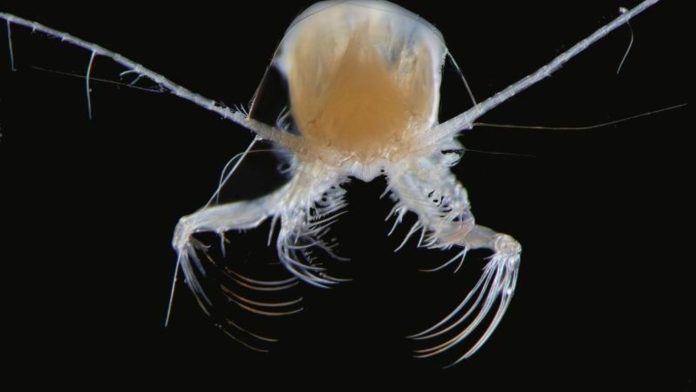
They modelled climate change’s effect on zooplankton, a large and diverse collection of microscopic invertebrates that account for around 40% of the world’s marine biomass.
Zooplankton are the fundamental link between phytoplankton — which converts sunlight and nutrients into energy as plants do on land — and fish. Antarctic krill, a primary food source for whales, and even jellyfish, are examples of zooplankton.
Dr Heneghan stated that despite their abundance, diversity, and vital role in transmitting energy from phytoplankton to fish, information on what influences the composition of zooplankton groups worldwide is sparse.
“This is a challenge, since if zooplankton are affected by climate change, this could have important implications for the ocean’s ability to sequester carbon emissions, and the productivity of fisheries,” Dr Heneghan said.
The researchers utilised a worldwide marine ecosystem model to investigate the influence of climate change on the significant zooplankton groupings, ranging from single-cell zooplankton to krill and jellyfish.
“We used the model to project changes in the zooplankton community in response to climate change, and then assess how these changes could affect the diet quality of small fish—the primary predators of zooplankton beyond the zooplankton themselves,” Dr Heneghan stated.
Dr Heneghan explained that the team had discovered that future climate change is driving changes in the composition of zooplankton communities across most of the world’s oceans. He added that these changes were caused mainly by decreased phytoplankton size due to climate change.
The researchers discovered that carnivorous groups, such as chaetognaths, and gelatinous groups, such as salps and larvaceans, will gradually dominate future zooplankton ecosystems at the expense of small crustacean omnivores like krill and copepods.
“In the oceans, energy is transferred from microscopic plankton up to fish and whales by size-based predation—big things eating small things,” Dr Heneghan said.
Gelatinous salps and larvaceans consume prey that is millions of times smaller than themselves. As a result, unlike other larger zooplankton that fish consume, this allows them to directly access smaller phytoplankton.
Salps and larvaceans thus offer a successful shortcut for the energy transfer from tiny phytoplankton, which is becoming more and more prevalent, to fish.
“This shortcut partially offsets the increase in the number of steps from phytoplankton to fish from shrinking phytoplankton and increases in carnivorous zooplankton,” Dr Heneghan said.
However, Dr Heneghan explained that it comes at a price because these groupings are gelatinous and contain 5% less carbon than omnivore zooplankton like krill and copepods.
He stated that this would be equivalent to substituting a bowl of jelly for a rib-eye steak in terms of nutrition.
“As a result, our model projects that the diet quality of small fish could decline across large areas of the world’s oceans, which would exacerbate declines in fish biomass from climate change by up to 10 per cent,” he added.
According to him, during a recent North Pacific marine heatwave known as “the Blob,” modifications to more gelatinous fish diets were previously noticed.
“The higher temperatures drove declines in phytoplankton production, which in turn drove decreases in the prevalence of carbon-dense krill, which were replaced by gelatinous zooplankton,” he said.
As a result, Dr Heneghan stated that small fish in the region changed to more gelatinous diets, resulting in weight and abundance reductions. Dr Heneghan added that the model results show a shift to more gelatinous diets for small fish may become more widespread as the ocean warms.
“For human societies, this could have far-reaching implications globally, since according to the United Nations Food and Agriculture Organization fisheries are a key ecosystem service worth US$150 billion a year and providing more than 20 per cent of dietary animal protein for 3.3 billion people, and supporting 60 million livelihoods,” Dr Heneghan said.
Dr Heneghan, Dr Jason Everett, Professor Julia Blanchard, Patrick Sykes, and Professor Anthony Richardson were all research team members.