
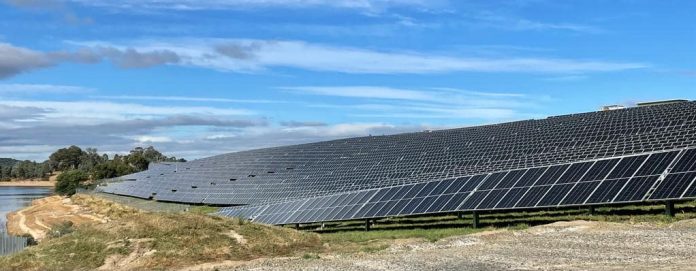
The Victorian Government announced the completion of the construction of a new solar farm at Winneke Treatment Plant in Melbourne’s northeast.
The project will assist Victoria in meeting its target of net zero emissions by 2045 and help the Victorian water sector supply 100% of its electricity demands from renewable energy sources by 2025.
“Victoria’s water sector is leading the nation on emissions reductions with the Winneke Solar Farm delivering a cleaner and cheaper energy supply for Melbourne Water’s operations,” Minister for Water Harriet Shing said.
According to Minister Shing, the solar farm employs cutting-edge technology to help reduce operating costs and contribute significantly to Victoria’s goal of reaching net zero emissions by 2045.
The Winneke Treatment Plant solar farm has 19,000 solar panels, creating roughly 12,400 megawatt hours of power each year – enough to power 2,500 homes – and prevent 12,000 tonnes of pollution.
The solar farm will go into operation later this year, with the energy generated going to the Winneke Treatment Plant, which is an integral part of Melbourne’s water distribution network and the third largest energy user in Melbourne Water’s infrastructure portfolio. Any extra energy will be fed back into the grid.
The solar farm covers 10 hectares and employs cutting-edge tracking sensors in conjunction with rotational motors to maximise sun exposure and energy generation all year.
The solar farm also has a walking pathway that allows the public to see the solar panels in action.
“This solar farm will be a great attraction for the local community to see first-hand the beauty of our renewable energy revolution and know that their local water service is doing its bit to reduce emissions,” Member for Eltham Vicki Ward said.
The Winneke Treatment Plant solar farm is one of several projects underway within the water sector to create renewable energy and reduce emissions as part of the sector’s goal of reaching net zero emissions by 2035.
A net zero water sector by 2035 will have decreased annual emissions by about 900,000 tonnes per year, which is equivalent to the annual emissions produced by more than 250,000 cars on Victoria’s roadways.