
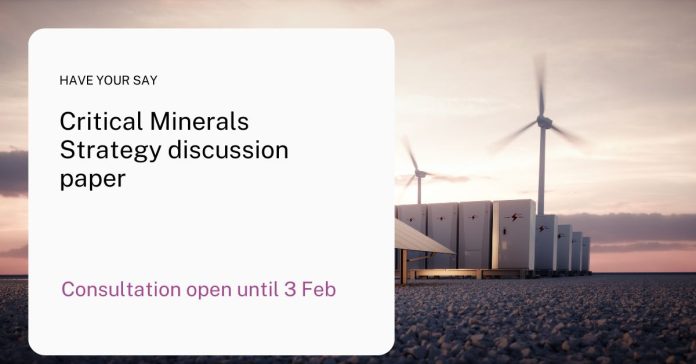
The Australian Government has released the Critical Minerals Strategy and launched public consultations on the future of Australia’s critical minerals sector and how it might grow to assist Australia become a clean energy superpower.
Minister for Resources and Northern Australia Madeleine King said the consultations would help guide the Federal Government’s new Critical Minerals Strategy and assist the sector in capitalising on the global demand for renewable energy technologies.
In a statement, Minister King claimed that Australia has an abundance of critical minerals such as lithium, silicon, and rare earths, which are key components of low-emissions technology such as batteries, solar panels, and electric vehicles, which will help Australia and the rest of the world reduce emissions.
“The Australian Government is committed to growing Australia’s critical minerals resources and industries which will be crucial to help Australia and the world to meet our commitments to net zero emissions by 2050,” Minister King stated.
According to Minister King, Australia has an exciting opportunity to use its vast critical mineral resources to help the development of low-emissions technology and to become a trusted, stable, and dependable supplier to the rest of the world.
“Critical minerals are also crucial for technologies that power our homes, offices, factories, vehicles and mobile phones, as well as for medical technology and defence applications,” Minister King added.
Minister King said the 2023 Critical Minerals Strategy would focus on creating economic opportunities, including for regional Australia, and on developing new sovereign capabilities in downstream processing and Australia’s manufacturing industries.
“By leveraging our competitive advantages, the critical minerals we mine and refine here, can help us move up the value chain and into downstream processing, helping to create new opportunities and high-paying jobs across Australia, including in our regions,” Minister King said.
The Minister claims Australia currently produces about half of the world’s lithium, is the second-largest producer of cobalt and ranks fourth in rare earth production.
However, during the next three decades, demand for low-emissions technology will likely surge, resulting in increased demand for lithium, cobalt, graphite, and rare earth elements, among others.
The Federal Government will bring together stakeholders from all sectors to guarantee that all perspectives on the sector’s possibilities, challenges, and solutions are heard to inform government policy.
According to the Minister, the issues raised in the discussion paper highlight the significance of the critical minerals sector to the Government and Australia’s desire to become a clean energy superpower.
It will also concentrate on assisting Australia in developing dependable, competitive, and diverse supply chains, attracting international partners and investment, and meeting Australia’s ongoing commitment to the highest environmental, social, and governance standards net zero goals.
Minister King further added that the new policy would guarantee that critical minerals are mined and processed in ways that benefit local communities, First Nations Australians, and the quality of Australia’s natural environment.
“We will consult widely with industry and community stakeholders, including First Nations Peoples, to develop a new strategy to build and strengthen the sector and attract investment,” Minister King said.