
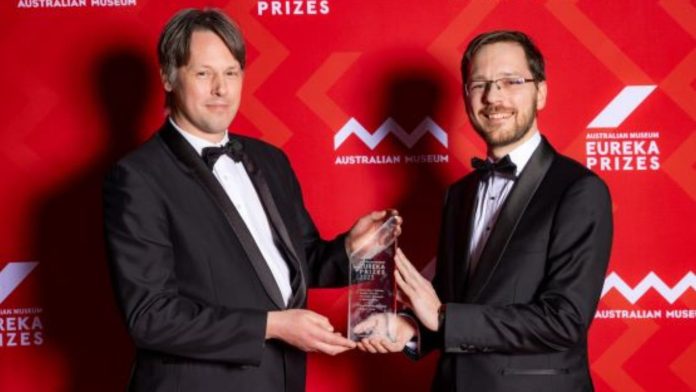
The Economic Fairways Mapper research team, a collaboration between Monash University and Geoscience Australia, was awarded the Eureka Prize for Innovative Research in Sustainability last night at the 2023 Australia Museum Eureka Awards ceremony.
Monash Engineering’s Dr Stuart Walsh and Geoscience Australia’s Dr Marcus Haynes led the research team that developed a world-first online platform that allows users to produce accurate maps to guide decisions about the location of resources for development projects.
The Mapper’s analysis helped underpin the Australian Government‘s multi-million dollar Hydrogen Hub strategy, which was launched in September 2021 and has guided contributions to government inquiries into hydrogen development.
According to Monash University, the Economic Fairways Mapper project has significantly impacted hydrogen energy development. The tool has been utilised in industry to help with the preliminary screening of possible projects in Australia.
According to Dr Walsh, the capability enables investments to be directed towards areas of strategic opportunity and Australia’s natural advantages. The Economic Fairways Mapper is positioning Australia to play a vital role in resourcing the transition to a low-emissions future by enabling better-informed investment decisions.
“I am extremely proud of the research team and this acknowledgement from the science community. This Mapper is extremely important and pivotal for the development of energy resource options across the world,” he said.
Geoscience Australia CEO James Johnson commended the research team for their efforts on the Economic Fairways Mapper tool.
“This recognition highlights not only our innovation but also our commitment to driving sustainable change into the future. Tools like this are vital for achieving net-zero emissions by 2050,” Johnson stated.
Dr Haynes noted that the tools would assist Australia in navigating the energy transition in the coming decades.
“This award is a wonderful recognition of the innovation and impact of the project so far,” he added.
Deputy Vice-Chancellor (Research) and Senior Vice President Professor Rebekah Brown said the prize recognised work that might be transformative for the global challenge of climate change.
“On behalf of Monash, we are thrilled and extremely proud of the researchers recognised with this distinguished award, acknowledging their hard work and dedication to excellence in research,” Professor Brown stated.
“This award acknowledges the project’s significant practical advances in renewable and sustainable energy for a low-carbon future. It is an outstanding achievement for the Faculty of Engineering, Monash University and Australia’s national science agency, and Geoscience Australia,” Professor Brown added.
The Australian Museum Eureka Prizes, presented annually in collaboration with some of the country’s leading scientific institutions, government organisations, universities, and corporations, recognise excellence in research and innovation, leadership, science engagement, and school science.