
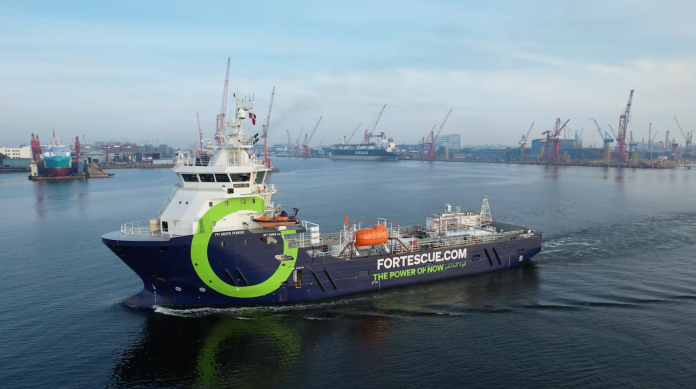
Fortescue’s green ammonia dual-fuel ship, Fortescue Green Pioneer, has sailed to Dubai for COP28, marking the need for technology solutions and regulatory changes to decarbonise shipping.
Fortescue Executive Chairman and Founder Andrew Forrest AO noted that the current regulatory landscape prohibits ammonia ship operations, requiring ports to ensure their logistics prevent those hiding from their responsibility to combat pollution.
“Now that green ammonia is emerging as a bulk marine fuel, it is now the time of the great ports of the world to become capable of pollution free shipping. All administrations of good character will not use inaction and excuses to stand in the road of progress to decarbonise one of the world’s dirtiest industries,” Forrest said.
“This is seriously limiting the progress of the decarbonisation of shipping. I look to the leadership of the world’s ports to make clear that running the world’s global shipping on dirty bunker fuel has to stop, as we have a pollution free alternative.”
Fortescue, in collaboration with top maritime engineers, has been working for 18 months to develop the necessary systems, processes, and technology for the Green Pioneer.
Earlier this year, Fortescue successfully adapted a four-stroke engine to run on a blend of ammonia and diesel at its Perth testing centre, marking a significant milestone in its goal of a worldwide shipping industry free of fossil fuels.
The company has since developed a full gas fuel delivery system and reconfigured two of Singapore’s four engines on the Green Pioneer proof-of-concept vessel to run on ammonia and diesel. Fortescue is now moving forward with its larger aim to build a world-first fuel transfer and maritime vessel powered by ammonia.
Fortescue has also pioneered and implemented new ammonia-specific safety and fuel handling courses in collaboration with a recognised Singapore learning institution to ensure that all seafarers are appropriately trained and can operate safely and controlled with ammonia fuel on board. This training can now be extended to the rest of the industry, allowing for the safe and widespread use of ammonia as a maritime fuel.
Dr Forrest has called for changes in regulations for world ports, causing the vessel to not carry ammonia or demonstrate its use as a fuel in Dubai. However, upon the ship’s return to Singapore, the company will complete commissioning for a world-first ammonia transfer and final flag and class approval, allowing the vessel to operate ammonia dual-fuel engines on water.
Because green ammonia is produced using renewable energy, a green ammonia-based replacement to diesel would be a game changer for reducing the carbon footprint of the world’s maritime industry, which would be the world’s sixth-largest polluter if it were a country.
While technological advances are encouraging, Fortescue is using the COP28 gathering to call on all enablers – including governments, port authorities, regulators, training institutions, and development banks – to move at a faster pace by ensuring the appropriate settings are in place for the use of ammonia as an alternative shipping fuel.