
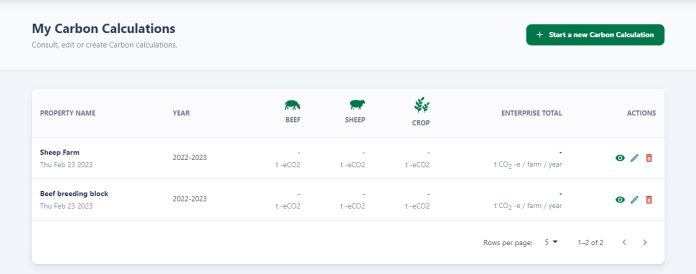
Meat & Livestock Australia (MLA) has released an online, web-based greenhouse gas calculator for Australian sheep and beef producers based on the Sheep and Beef Greenhouse Accounting Framework (SB-GAF) tool.
The digitised version of the SB-GAF tool is based on the freely available excel version of the instrument available on the Primary Industries Climate Challenges Centre (PICCC) website to guarantee consistency throughout the sector.
According to MLA’s Managing Director Jason Strong, compiling a carbon account is a vital first step for producers to raise their carbon awareness and quantify their net greenhouse gas emissions situation, allowing them to create methods to reduce these emissions and boost carbon storage on-farm.
“Calculating baseline carbon emissions and sequestered carbon is an essential first step for producers who are considering opportunities arising from low or zero carbon red meat, such as carbon-neutral branded products, or who simply want to improve their productivity and profitability,” Strong said.
Strong stated that a carbon account could be used to make on-farm decisions and serves as a benchmark for measuring progress over time. Carbon accounting, like financial accounting, supports decision-making and reporting about how carbon is – or is not – used on-farm.
Strong explained that the calculator also allows for the computation of an emissions intensity number and enhances farm data gathering and storage capabilities.
“Calculation and reporting of on-farm emissions and emissions intensity for red meat products are likely to be a requirement for ongoing and emerging market access in the future, and the improvement to the usability of this process will support red meat producers in the process,” Strong added.
The calculator will generate a baseline carbon account that includes the property’s overall greenhouse gas emissions and the emissions intensity of the product generated.
The calculator will improve on-farm data collecting and storage capacities and ensure relevant information is available when market opportunities requiring historical data materialise.
According to MLA, a carbon account is a crucial tool for business planning since it helps producers to understand where they stand and where they can improve.
Greenhouse gas emissions, including enteric methane from ruminant production and carbon dioxide from fossil fuels, and direct and indirect nitrous oxide emissions from fertiliser application and excreta and methane from manure, are included in a carbon account.
The carbon associated with on-farm vegetation and soils is also an important consideration when constructing a carbon account.
The MLA added that reduced greenhouse gas emissions could result in various benefits, including enhanced production and long-term sustainability, improved customer and community support, and the consolidation of current market access.
Carbon accounts also enable access to new and expanding markets for products displaying environmental stewardship credentials, as well as access to funding and ensuring red meat production’s adaptation and resilience in the face of changing climatic conditions.