

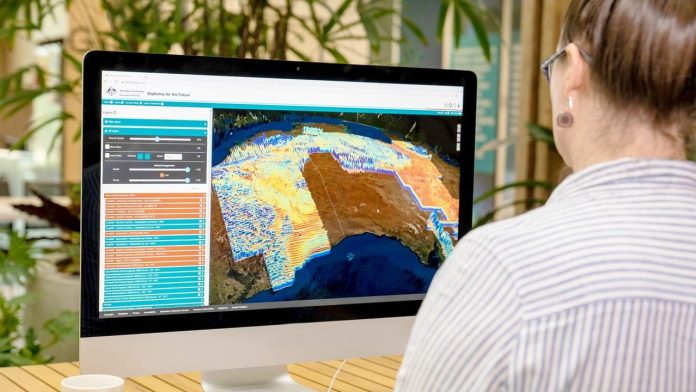
The largest survey of aerial electromagnetic (AEM) data has been gathered across the entirety of Western Australia (WA).
This data collection will improve knowledge of the geology and resource potential of the State and provide the sector with vital information to guide more focused surveying.
Minister for Resources and Northern Australia Madeleine King announced that mapping the Earth’s conductivity to a depth of 500 metres, which required significant data collection, was finally finished.
“This data will deepen our understanding of groundwater, minerals, including critical minerals, and hydrogen storage which are all essential in our transition to net zero emissions by 2050,” Minister King said.
According to Minister King, industry and the CSIRO are already using this information to advance the search for minerals and clays that contain rare earth elements, which will be essential for developing sustainable energy in the future.
“As we strive towards our new net zero economy, we have already seen this data be used to map salt for hydrogen storage, uncovering great potential for the development of multiple caverns underground in salt deposits,” Minister King added.
The Exploring for the Future initiative of Geoscience Australia and the Exploration Incentive Scheme of the WA Government, which was overseen by the Geological Survey of Western Australia (GSWA), allowed for the creation of the mapping program.
Western Australian Minister for Mines and Petroleum Bill Johnston commended GSWA and Geoscience Australia for successfully completing the project.
“This survey is a major achievement that will keep Western Australia at the forefront of geoscientific understanding,” Minister Johnston said.
According to Minister Johnston, the survey is a significant accomplishment that will keep WA at the top of the geosciences.
“Exploration is the lifeblood of our resources sector, and I am confident the AEM survey’s data will help uncover the State’s next big discovery. It’s encouraging to see that exploration companies are already using data to target in-demand battery and critical minerals such as nickel, graphite and rare earths elements,” Minister Johnston added.
Many companies have already targeted basement anomalies discovered in the survey lines using the early-release AEM data from the study.
At its Narryer nickel-copper-platinum group elements (PGE) project in the West Kimberley, Buxton Resources discovered an undiscovered bedrock conductor earlier this year.
While Torque Metals’ Paris Project in the Eastern Goldfields has discovered anomalies that could point to nickel mineralisation, Mamba Exploration has detected targets at its Copper Flats project in the East Kimberley.
Minister King stated that the Australian Government is committed to collaborating with state and territory governments to accelerate Australia’s transition to a clean energy superpower.
“This work with Western Australia is critical to our ongoing transition and is just one way we are delivering on that commitment,” Minister King added.
Since 2016, the $225 million Exploring for the Future program has been collecting preliminary data on Australia’s geology.
It puts critical information in the hands of Australians, creating jobs in regional towns and allowing government, communities, and industry to make better decisions.
Much of the data collected for WA is currently available through the Exploring for the Future Data Discovery Portal, with the final instalment anticipated in the new year.










 data has been gathered across the entirety of Western Australia (WA).)