
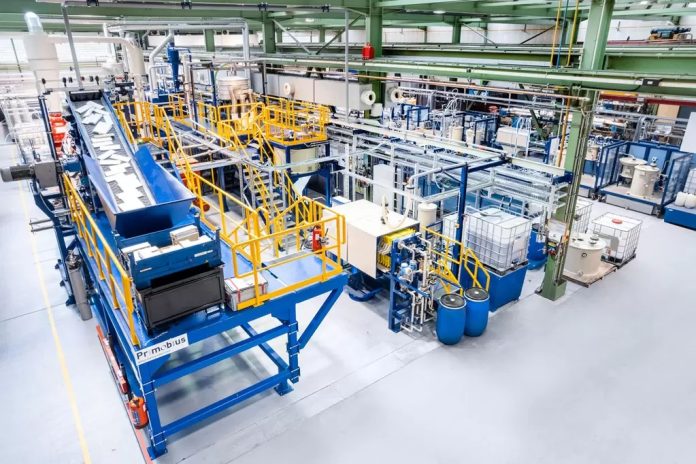
Battery materials recycler Neometals Ltd announced that a life cycle assessment (LCA) had demonstrated the potential for Primobius’ LiB recycling plants to produce key battery materials with exceptionally low carbon footprint.
Primobius has engaged Minviro Ltd to conduct the LCA, which focused on Primobius’ production of key battery materials such as lithium fluoride (LiF), nickel sulphate hexahydrate, and cobalt sulphate heptahydrate, (Primary Products).
“The LCA evidences the sustainability of Primobius’ recycling plants and their potential to largely remove embedded carbon from the battery materials supply chain. Our hydrometallurgical recycling plants can deliver customers a secure supply of low-cost battery materials to satisfy their environmental ambitions and meet legislative requirements for new batteries to utilise recycled content,” Neometals Managing Director Chris Reed said.
Primobius’ 2023 engineering cost study followed ISO-14040:2006 and ISO-14044:2006 standards, including Scope 1, 2 and 3 emissions, subject to third-party ISO-compliant critical panel review.
Traditionally, the processing of mined raw materials has dominated the manufacturing of Primary Products. The Minviro LCA comparative scenarios discovered that Primobius will have a lower GWP than the equivalent manufacture of Primary Products via mined extraction with downstream Chinese and Indonesian processing. This is partly due to the fewer processing steps required when aiming for a feed source (i.e. batteries) with intrinsically higher grade (>15% Ni/Co; 2.5% Li) than mined raw materials. Regional recycling minimises the high carbon footprint associated with the logistics of the mined battery material supply chain by recycling LiBs locally.