
A QUT-developed genetically modified (GM) variant of Cavendish banana (QCAV-4) aimed at saving the world’s Cavendish banana output has been submitted to the Australian Government for regulatory approval.
The QCAV-4 banana is Australia’s first GM fruit to be submitted for evaluation. If authorised, it might provide a safety net against the catastrophic Panama Disease tropical race 4 (TR4), which threatens the world’s $20 billion banana industry.
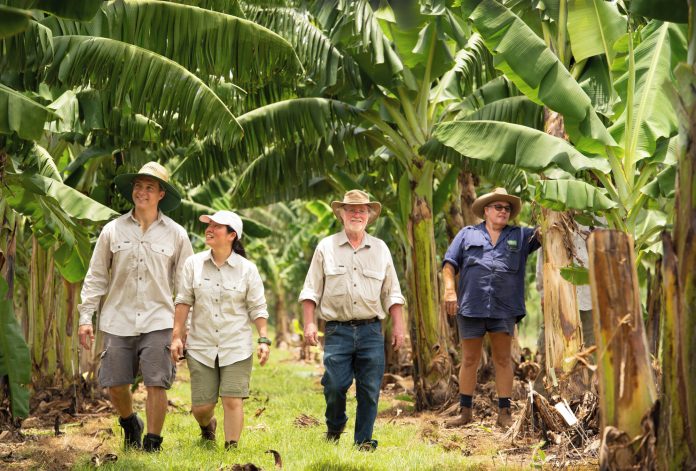
According to QUT, QCAV-4 bananas, developed in collaboration with government and industry, have been produced in Northern Territory field trials for more than six years and have proved to be highly resistant to Panama Disease TR4.
The university added that Panama Disease TR4 has already damaged Cavendish banana output in Asia, is making inroads into South America, and is present in Australia’s Northern Territory and North Queensland.
A single gene, RGA2, from the wild, south-east Asian banana Musa acuminata ssp malaccensis, was used to bioengineer QCAV-4, a Cavendish Grand Nain banana. The RGA2 gene is already present in Cavendish bananas, but it is dormant.
The Australian Government’s regulatory agencies, including Food Standards Australia New Zealand (FSANZ) and the Office of the Gene Technology Regulator (OGTR), are currently evaluating QCAV-4.
QUT Distinguished Professor James Dale and his team have been working on creating and cultivating genetically modified Cavendish bananas for over 20 years.
“The devastating Panama Disease TR4 is caused by a soil-borne fungus that stays in the ground for more than 50 years, wiping out banana crops and destroying farms for generations,” Professor Dale said.
According to Professor Dale, Panama Disease TR4 is a major issue since it has damaged Cavendish plantations in many regions of the world and has the potential to ruin the Cavendish banana export sector globally.
Although Australia’s world-class biosecurity regulations have reduced the impact of Panama Disease TR4 on the majority of the Australian sector, it has been identified in sections of North Queensland and has destroyed the Northern Territory’s commercial banana production.
Professor Dale stated that Queensland grows over 95% of Australia’s bananas, with the Cavendish banana accounting for 97% of output.
“Apart from providing a genuine protection against Panama Disease TR4 for the world’s export industry, QCAV-4 is a safety net for Australia’s $1.3 billion industry, which includes protected employment for 18,000 Queenslanders involved in banana production,” Professor Dale said.