
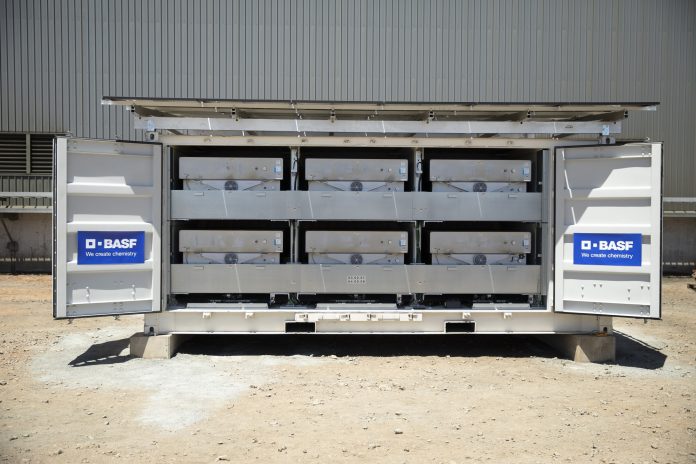
QUT researchers, as part of the National Battery Testing Centre (NBTC) project, installed the country’s first large-scale sodium-sulfur battery (NaS battery) at IGO‘s Nova nickel-copper-cobalt mine site.
The NaS battery energy storage system (BESS) is a modular base unit with a capacity of 250 kW/1.45 MWh capacity that can be placed at a gigawatt scale. The NaS BESS is designed for large-scale energy storage applications of six hours or more, and it can operate in high heat without air conditioning.
The deployment of the demonstration unit in the Australian market will provide long-duration storage, led by BASF and IGO, as part of their participation in the Future Battery Industries Cooperative Research Centre’s (FBICRC) NBTC, which QUT runs.
BASF Stationary Energy Storage GmbH, a BASF SE subsidiary, distributes NaS batteries.
“Deploying and testing the first NaS battery in Australia is a significant milestone with the potential to enable further uptake of these systems domestically. The NaS BESS has the potential to play an important role in Australia’s clean energy transition by enabling stable and on-demand power from our intermittent renewable energy generation sources,” NBTC QUT Project Lead Dr Joshua Watts said.
FBICRC Chief Executive Officer Shannon O’Rourke welcomed the news.
“These field deployments help build market confidence, train our workforce and build capability in the contracting community. The NaS battery technology is commercially mature and has been successfully installed and operated at over 250 sites worldwide over the past 20 years,” O’Rourke stated.
Allset Energy, BASF’s Australian engineering, procurement, and construction partner, was the primary contractor in charge of the design, building, and commissioning at IGO’s Nova mine site.
According to Allset Energy Managing Director Thomas Buschkuel, the NaS battery provided a unique solution that supported 24/7 carbon-neutral operations for large commercial, industrial, and utility-scale applications.
“As Australia pursues its renewable energy targets, this long-duration energy storage solution enables a higher penetration of renewables while stabilising the electricity grid,” Buschkuehl said.
The NaS BESS, which has been operational since mid-February, was deployed and commissioned in under 15 days by Allset Energy’s specialist team.
The NBTC team, along with BASF and Allset Energy, will remotely monitor the NaS battery’s performance. The University of Western Australia will use performance data to model the battery to better understand the NaS BESS and how it may be best used within the Australian power infrastructure.
“These kinds of demonstrator projects are key to enabling a diverse range of energy storage technologies within Australia. QUT and the NBTC are pushing forward with many more collaborative projects in this space to accelerate Australia’s clean energy transition,” Dr Watts said.
The FBICRC’s National Battery Testing Centre, which QUT operates at their Banyo Pilot Plant facility on Brisbane’s northside, is supported under the Australian Government‘s CRC grant program and is Australia’s first facility of its sort. It is one example of QUT’s nation-leading initiatives to accelerate novel energy storage solutions to help Australia’s decarbonisation efforts.