
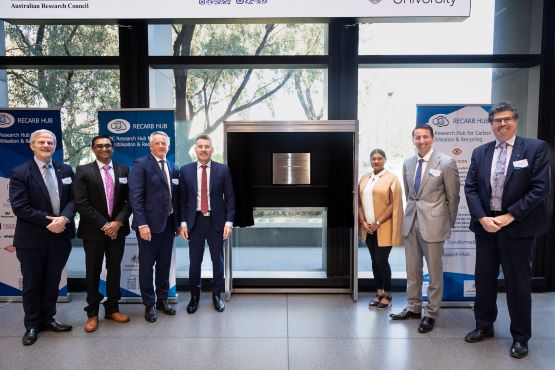
Monash University opens the new Australian Research Council (ARC) Research Hub for Carbon Utilisation and Recycling (RECARB), aiming to convert CO2 emissions from energy and manufacturing sectors into useful products and developing markets for these carbon-embedded products.
The launching of the research hub is led by Federal Member for Holt Cassandra Fernando MP, on behalf of Minister for Education Jason Clare MP.
On 11 August 2023, the Hub embarked on a five-year program led by Professor Paul Webley with Deputy Director Professor Akshat Tanksale.
The RECARB Hub will play an essential role in Australia’s transition to a net zero emissions economy by developing and piloting cutting-edge technology that will help to reduce, reuse, and transform carbon emissions into valuable products like acetic acid, stock feed, methanol, and other chemicals.
The Hub will also develop low-cost, scalable, green methods to convert CO2 to intermediate and high-value products.
“We need to change our thinking of carbon emissions from pollutants to useful feedstock. The RECARB hub aims to catalyse this change in thinking by working with industry, government, and university partners to develop and provide high quality solutions especially for the hard-to-abate sectors. The Hub will become Australia’s leading research initiative for leading the decarbonisation journey,” Professor Webley said.
He also noted how research hubs provide a platform to unite the industry and academia to develop and apply industry-relevant research to practice.
“Monash has an outstanding track record in working with industry and university partners to develop high impact research. As one of Australia’s leading universities with a strong emphasis in sustainability, our Hub is well placed to lead the way in carbon recycling and reuse for future applications,” Professor Webley noted.
The research on the Hub will cover electrochemical, thermochemical, and biological technologies, including a study into direct air capture technology (DAC) for CO2 recycling.
DAC offers a sustainable CO2 source that can benefit agriculture and be transformed into usable products.
Plasmonics is also an emerging transformative field within the energy and chemical manufacturing sectors that offers possibilities for the photochemical conversion of CO2 into valuable chemicals and the exploration of multifunctional metal plasmonic nanomaterials that can revolutionise the harnessing of solar energy.
“Our aim is to develop pilot scale applications of CO2 to products and CO2 recycling so that industry can scale up and assess these processes for their business. For this research to make a difference to the environment we need to identify methods and frameworks for embedded emissions accounting that can unlock growing markets for abated carbon products and services,” Professor Tanksale said.
ARC is supporting the RECARB Hub through a $5 million investment, along with another $5.8 million from universities and industry partners and $11.8 million in-kind contributions.