
Australia’s resources and energy exports’ value is expected to decline from its record high in 2022-23 over the next two years as commodity prices return to normal levels.
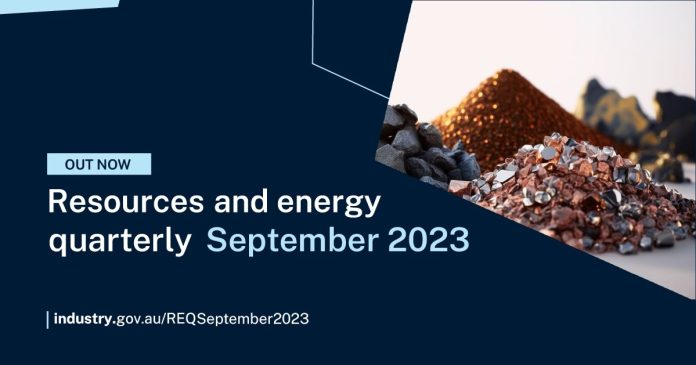
The Department of Industry, Science and Resources’ September 2023 Resources and Energy Quarterly forecasts a decline in resources and energy export values to $400 billion in 2023-2024 and $352 billion in 2024-2025 as demand softens and global supply stabilises. This is a decrease from record $467 billion in 2022-2023.
The outlook largely aligns with forecasts in the Resources and Energy Quarterly’s March and June issues, with the lower Australian dollar driving the higher revisions.
Minister for Resources and Northern Australia Madeleine King said lower earnings were due to sluggish global growth and supply issues, exacerbated by Russia’s invasion of Ukraine, flooding in Australia and Indonesia, and COVID-related workforce issues.
“While overall export revenue is easing from record highs, Australia’s resources and energy exports remain strong and continue to underpin Australia’s economic wellbeing,” Minister King stated.
“Australia remains a reliable and stable supplier of resources and energy to our export customers, and we are working to build investment, partnerships and supply chains for our critical minerals sector which will help the world meet commitments to lower emissions,” she added.
The September 2023 Resources and Energy Quarterly also highlights Australia’s leading role as a global exporter of battery minerals like lithium, cobalt, copper, and nickel, driven by the increasing global demand for electric vehicles.
“During my visit to Europe and the UK over the past week I met with leaders in government and industry seeking access to Australian critical minerals and rare earth elements,” Minister King said.
“Demand for Australia minerals is growing as the world works to build the technology needed to decarbonise.”
According to the September 2023 Resources and Energy Quarterly, worldwide prices for most significant resources and energy commodities have declined in the last three months.
Iron ore export revenues are predicted to fall to $120 billion in 2023-24 from $124 billion in the previous fiscal year. As prices decline, earnings are expected to fall further to $99 billion in 2024-25.
LNG earnings are expected to fall from $93 billion in 2022-23 to $71 billion this year and $63 billion in 2024-25. Lower energy costs are expected as a result of Russia’s invasion of Ukraine, according to the forecasts.
Australian lithium exports are expected to decrease to $18 billion this year and $16 billion in 2024-25, from a record $20 billion in 2022-23. Australia’s refinery capacity will increase its capacity to refine spodumene ore, enabling the growth of lithium hydroxide exports over time.
Earnings from metallurgical coal, which is used for steel making, are predicted to fall to $47 billion this year and $41 billion in 2024-25, down from $62 billion last year. Earnings from thermal coal are expected to be $36 billion in 2023-24 and $28 billion in 2024-25, down from $66 billion in 2022-23.