
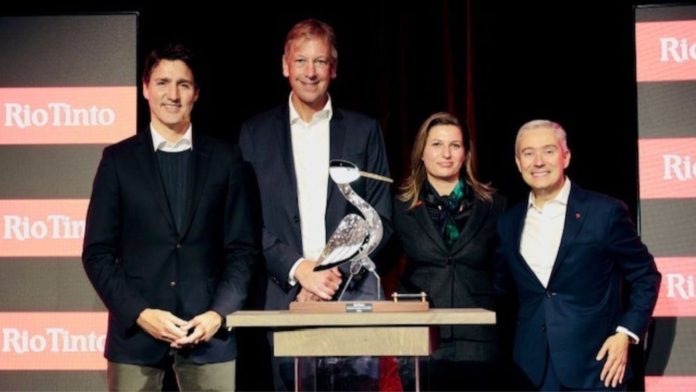
Rio Tinto is partnering with the Canadian Government to decarbonise the Rio Tinto Fer et Titane (RTFT) operations and establish the company as the centre of excellence for essential minerals processing.
The collaboration will fund technological advancements that will reduce greenhouse gas emissions from RTFT’s titanium dioxide, steel, and metal powders businesses by up to 70 per cent. It will also further attempts to diversify RTFT’s product portfolio, bolstering Rio Tinto’s position as a North American supplier of vital minerals for important growth areas like electric cars, 3D printing, and aerospace.
Through its Strategic Innovation Fund (SIF), which supports expansive, transformative, and collaborative projects that will assist in positioning Canada to progress in the global knowledge-based economy, the Government of Canada is investing up to C$222 million (US$162 million) over the next eight years to support these initiatives.
Rio Tinto Chief Executive Jakob Stausholm said in addition to discovering new ways to create the resources required for the shift, Rio Tinto is dedicated to being a part of a net zero future.
“We are excited to collaborate with the Government of Canada to position RTFT for the future and strengthen the critical minerals and metals value chains in Canada and the United States,” Stausholm stated.
Canadian Prime Minister Justin Trudeau said Canada’s vision for a healthy economy and a strong future includes good middle-class employment, clean air, and Canadian-made technology.
“Today’s announcement is about delivering on that vision and positioning Canada as a leader in critical minerals – a key part of things like electric vehicles. Together, we will continue to innovate, create good jobs, and keep our air clean,” Prime Minister Trudeau added.
According to Minister of Innovation, Science and Industry François-Philippe Champagne, supporting the expansion of Canada’s vital supply chain for minerals will guarantee that our nation maintains its position as a world leader in this vital industry.
“Our government is committed to the sustainable development of critical minerals resources, creating good jobs, and building strong global supply chains while strengthening trade relationships with Canada’s closest allies,” Minister Champagne added.
The partnership will support projects such as:
BlueSmelting
The BlueSmelting project is an ilmenite smelting technology that could produce 95 per cent fewer glasshouse gas emissions than RTFT’s current reduction process, making it possible to produce steel and metal powders with a significantly smaller carbon footprint as well as high-grade titanium dioxide feedstock.
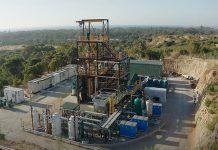
At the RTFT metallurgical complex in Sorel-Tracy, a demonstration plant is now being built to test and validate the technology created by researchers at Rio Tinto’s Critical Minerals and Technology Centre. The demonstration plant’s construction is anticipated to be finished in the first half of 2023 and can process up to 40,000 tonnes of ilmenite ore annually.
If wholly implemented, the BlueSmelting project could result in a reduction of up to 70 per cent in RTFT’s overall greenhouse gas emissions, which would be the equivalent of taking 145,000 cars off the road or a decrease of almost 670,000 tCO2e based on emissions in 2021.
Increasing scandium production
Rio Tinto is planning to quadruple its production capacity to reach up to 12 tonnes of scandium oxide per year from the current nameplate capacity of three tonnes. Rio Tinto was the first North American producer of scandium, a vital mineral used in solid oxide fuel cells and aluminium alloys, earlier this year.
The current facility will get new modules, which extract high-quality scandium oxide from the waste streams of titanium dioxide production without additional mining. Production of the C$30–35 million (US$22–26 million) project is anticipated to begin in 2024.
Adding titanium metal to the portfolio
The extraction and refinement of titanium metal, a high-performance material utilised in the aerospace, automotive, and medical industries, is being advanced by Rio Tinto in collaboration with other titania industry partners.
To confirm this inexpensive method that uses no hazardous chemicals and doesn’t produce any direct greenhouse gas emissions, Rio Tinto is establishing a pilot plant at the RTFT metallurgical complex. It’s anticipated that the facility will be finished by the end of 2023.
While enhancing the security of supply for this essential mineral for Canadian and American industries, Rio Tinto said the project has the potential to significantly enhance the production of raw titanium metal in North America.