
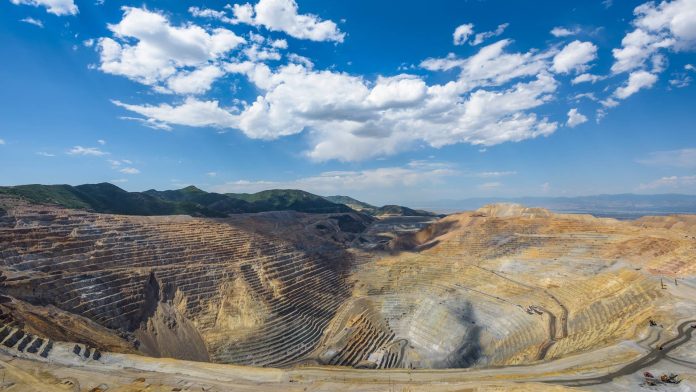
Rio Tinto has approved a $55 million investment to begin underground mining and enhance production at its Kennecott copper operations in Utah, USA.
In a statement, Rio Tinto said along with open-cut operations, underground mining will first concentrate on an area known as the Lower Commercial Skarn (LCS), which will provide a total of about 30kt of additional high-quality mined copper until 2027.
The first ore is anticipated to be produced in early 2023, with total production beginning in the second half of the year. It will be processed at Kennecott, one of just two working copper smelters in the United States.
According to Rio Tinto, Kennecott has the potential for substantial and appealing subsurface development. With drilling-identified Mineral Resources of 7.5 Mt at 1.9 per cent copper, 0.84 g/t gold, 11.26 g/t silver, and 0.015 per cent molybdenum and a Probable Ore Reserve of 1.7 Mt at 1.9 per cent copper, 0.71 g/t gold, 10.07 g/t silver, and 0.044 per cent molybdenum, Rio Tinto said the LCS represents the first step in this direction.
Kennecott is now testing underground battery electric vehicles to enhance worker health and safety, boost productivity, and lower carbon emissions from future underground mining fleets. The performance and usability of a battery-powered haul truck and loader provided by Sandvik Mining and Rock Solutions are being assessed as part of underground development activities.
Rio Tinto Copper Chief Executive Bold Baatar said the investment would enable the company to bring more volume of high-quality copper to the market and strengthen Rio Tinto’s knowledge and skills as it evaluates bigger-scale underground mining at Kennecott.
“We are progressing a range of options for a significant resource that is yet to be developed at Kennecott, which could extend our supply of copper and other critical materials needed for electric vehicles and renewable power technologies,” Baatar stated.
Baatar added that testing underground battery electric vehicles is an important milestone in Rio Tinto’s efforts to make the mine a safer environment for its personnel, boost mine production, and reduce pollutants from its operations.
Existing underground infrastructure is being expanded to allow for early access to the next underground resource and to conduct characterisation studies. The completion of a feasibility study to guide decisions on the next phase of underground production is scheduled in 2023.
In addition, feasibility studies are being conducted to continue open pit mining at Kennecott beyond 2032.