

Rio Tinto announced it’s planning the development of a larger-scale pilot plant to further evaluate its ability to help decarbonise the steel value chain.
The announcement comes as Rio Tinto claimed it had demonstrated the efficiency of its low-carbon iron-making process at a small-scale pilot plant in Germany using ores from its Australian mines.
In a statement, Rio Tinto said the BioIron™ process uses raw biomass as a reductant instead of metallurgical coal and microwave energy to transform Pilbara iron ore to metallic iron in the steelmaking process. BioIron™ has the potential to sustain near-zero CO2 steel production and, when combined with carbon capture and storage, can result in net negative emissions.
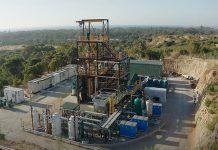
The procedure has undergone rigorous testing in Germany over the previous 18 months by a project team from Rio Tinto, Metso Outotec, and the University of Nottingham’s Microwave Process Engineering Group. A small-scale pilot plant was used to do development work, employing batches of biomass briquettes and iron ore the size of 1,000 golf balls.
Rio Tinto Chief Commercial Officer Alf Barrios said finding low-carbon methods of producing iron and steel is essential if Rio Tinto is to successfully combat climate change. Barrios stated a promising advance, considering the implications for global decarbonisation, is the demonstration that BioIron operates at this scale.
“The results from this initial testing phase show great promise and demonstrate that the BioIron process is well suited to Pilbara iron ore fines. BioIron is just one of the pathways we are developing in our decarbonisation work with our customers, universities and industry to reduce carbon emissions right across the steel value chain,” Barrios added.
Hatch, a global engineering, project management, and professional services business, affirmed BioIron™’s potential in a thorough and impartial technical examination. Hatch praised the team’s meticulous work and BioIron™’s ability to cut greenhouse gas emissions while transforming Pilbara iron ore into iron and steel.
The BioIron™ process will now be tested on a bigger scale in a specifically constructed continuous pilot plant with a one-tonne-per-hour capacity. The design of the pilot plant is underway, and Rio Tinto is considering possible locations for its installation.
The BioIron™ method employs lignocellulosic biomass, such as agricultural byproducts (such as wheat straw, canola stalks, barley straw, and sugar cane bagasse) or purpose-grown crops. The biomass is mixed with iron ore and heated using a combination of the biomass’s combusting gases and high-efficiency microwaves generated by renewable energy.
Rio Tinto said it is aware of the complications associated with biomass supply and is working to ensure that only sustainable biomass sources are utilised. As a result, Rio Tinto is conducting a benchmarking study of biomass certification systems. Rio Tinto has ruled out sources that encourage the logging of old-growth and High Conservation Value forests as the first step in conversations with environmental groups.