
Sparc Technologies announced that Sparc Hydrogen had signed a Kick-Start agreement with the CSIRO to conduct on-sun testing of Sparc Hydrogen’s photocatalytic water splitting (PWS) reactor at the CSIRO Energy Centre.
Sparc Hydrogen is a joint venture between the University of Adelaide, Fortescue Future Industries (FFI), and Sparc Technologies.
The prototype testing is scheduled for Q3 2023, corresponding to Sparc’s ASX announcement on 3 March 2023. The primary goals of the effort are to develop Sparc Hydrogen’s PWS reactor’s technology readiness level (TRL) and to offer vital data and information for the upcoming piloting phase.
“Sparc is delighted to be working with our Sparc Hydrogen partners, The University of Adelaide, FFI and Flinders University, to undertake this testing with the CSIRO, in what we believe to be a world leading demonstration of photocatalytic water splitting in a concentrated solar field,” Sparc Technologies Executive Chairman Stephen Hunt said.
“Completion of this test work will be a significant milestone, not only for Sparc Hydrogen, but more widely for the advancement of photocatalytic water splitting, a next generation green hydrogen production technology which does not require capital intensive electrolysers nor solar or wind farms,” Hunt stated.
According to Sparc, Sparc Hydrogen’s PWS reactor prototype testing in real-world settings concludes more than 5 years of research and development effort by the University of Adelaide and Flinders University. The company reported that a successful laboratory proof of concept had been achieved, with numerous lab-scale reactor prototypes constructed and tested under simulated sun concentration. Sparc added that the research has proven that exposing specific photocatalyst materials to intense light and heat improves hydrogen generation and efficiency. A high-power solar simulator was recently obtained from the United States to help accelerate laboratory research while designing and developing pilot plants.
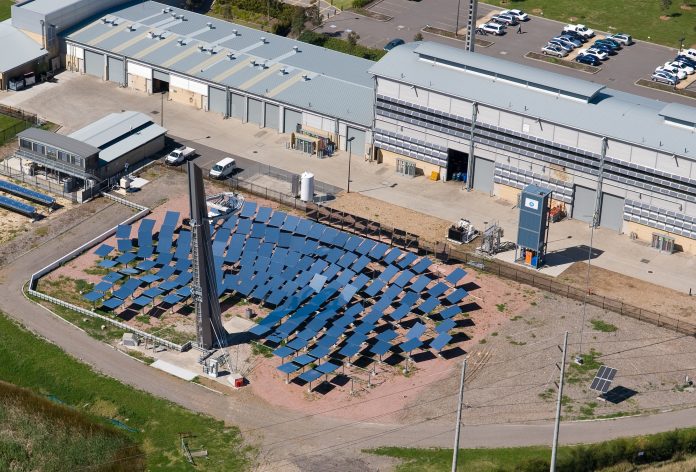
The CSIRO Energy Centre in Newcastle was chosen as the appropriate location for the first on-sun Sparc Hydrogen’s PWS reactor testing. The facility houses Australia’s largest solar thermal research facility. The hub consists of a 30-metre-tall solar tower surrounded by a 4,000-square-metre field of 451 locally produced solar panels. It uses specially engineered mirrors (heliostats) to generate temperatures of up to 1,500 degrees Celsius. The centre provides a forum for Australian academics to develop, test, and commercialise concentrated solar technology.
Sparc Hydrogen has received $28,688 in funding from the CSIRO Kick-Start Program to help cover the expenses of prototype testing.
The prototype reactor module has been designed, and construction, including the remainder of the facility, has begun. Sparc Hydrogen plans to start building the prototype at the CSIRO in late July 2023, with findings expected in four weeks. Depending on the results, a second round of testing will be considered later in the year.
The key aims of the prototype testing include:
- Advancing the TRL of Sparc Hydrogen’s PWS reactor from 4 to 51, bringing it one step closer to commercialisation.
- Providing essential data and information for the design of the pilot plant reactor.
- To allow benchmarking of laboratory testing under simulated solar conditions with real-world outcomes.
- Establishing Sparc Hydrogen as a world-leading proponent of PWS technology, with a functional reactor to test new and improved photocatalysts being developed by premier research organisations worldwide.