
Waroona Energy Inc. has announced the start of a study to evaluate a Dual Fuel Hydrogen Peaking Plant at its Waroona Renewable Energy Project in Western Australia.
Waroona Energy has begun a study to evaluate the feasibility of a minimum 100 MW dual fuel peaking power facility at the Waroona Renewable Energy Project. The Study will be undertaken with the aid of Frontier Energy under the terms of the existing Collaboration Agreement. Frontier issued a Definitive Feasibility Study on their Bristol Springs Hydrogen Project in March 2023, highlighting the Project’s potential to be one of Australia’s lowest-cost hydrogen plants.
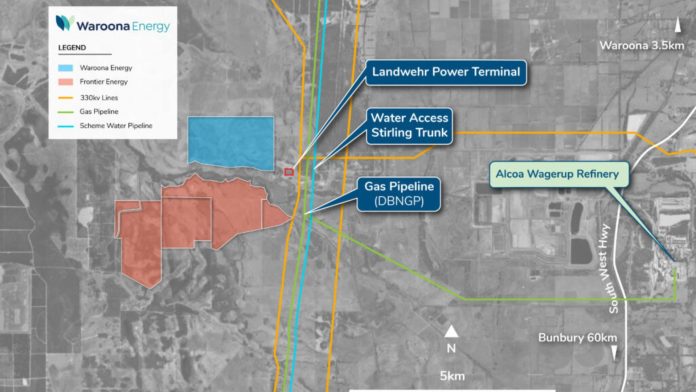
The Peaking Plant will be powered by natural gas delivered by suppliers and transmitted via the Dampier to Bunbury Natural Gas Pipeline (DBNGP). At the same time, renewable hydrogen will be created from the Project’s solar energy or Frontier’s Bristol Springs Renewable Energy Project.
“To be a successful early mover in the hydrogen industry, you not only need the potential for low-cost hydrogen production with scalability, but also a clear pathway for commercialisation through existing markets and mechanism,” President and CEO Adam Kiley said.
Kiley stated that Waroona is fortunate to be adjacent to and have access to two of the most advanced and plausible avenues for delivering green hydrogen at this early point in the sector’s growth. Kiley noted that the first method is to pump hydrogen directly into the DBNGP, which was previously demonstrated to be ready for hydrogen injection. Accordion to him, the second is through power generation, which is accessible through the Company’s existing link to the Western Australian electricity grid.
“The Peaking Plant opportunity would not only see the Company create its own pathway for renewable hydrogen consumption, but also assist Western Australia with its medium-term baseload energy supply, given the planned closure of coal fired power generation assets by 2029. Coal currently provides 30% of the State’s baseload energy needs which increases during “peak energy periods” (3pm to 9pm),” Kiley added.
The company has chosen several highly qualified engineering organisations to submit bids for project design. The scope comprises:
- Outline the chosen alternatives for the various reference dual fuel Power Plant, engineering, permits, and emissions analysis/pathways;
- Estimate the capital and yearly fixed costs for the reference technologies;
- Provide the reference dual-fuel power plant’s projected system services and net energy market revenues; and
- Provide an overview of the Capacity Market and explain how the Reserve Capacity Price will likely be employed.
This study is scheduled to be finished in late 2023.