
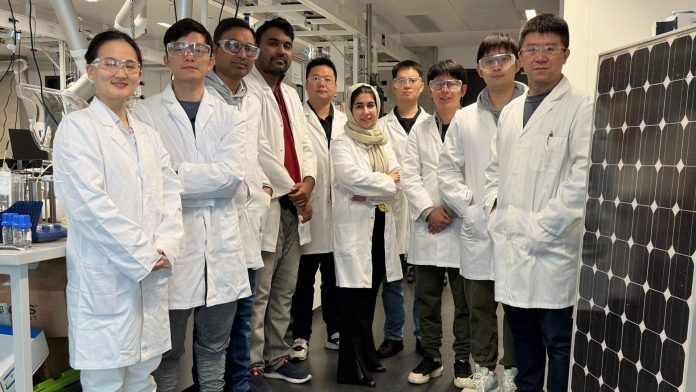
Engineers at UNSW Sydney have developed a new, more efficient solar panel recycling process that can efficiently recover silver.
The patented process is efficiently sorting component materials in photovoltaic panels for optimal recycling, guaranteeing quick and efficient material sorting in photovoltaic panels.
A team from the ProMO lab, led by Professor Yansing Shen, unveiled a new process that effectively separates 99% of PV cell particles.
Professor Shen said PV panels typically last 20 to 25 years, so with the rise in residential solar power since the 1990s, there is a compelling and urgent need to address the first generation of panels nearing the end of their end-of-life.
“We want to reuse and recycle those panels, but at the moment there is very limited research and very limited technology to allow us to do so effectively and prevent them from just ending up in landfill,” Professor Shen noted.
“Putting solar panels into landfill is a big issue because there are a number of harmful metals in the panels that can pollute the soil and pollute the water. So for environmental reasons we also need to find a better way to recycle the panels. At the same time, the end-of-life is a source of many valuable metals like silver if they can be properly recycled,” Professor Shen stated.
According to the International Renewable Energy Agency, the global cumulative PV waste volume will reach up to eight million tonnes by 2030. That amount might rise to 78 million tonnes by 2050 as successive generations of solar panels installed at the turn of the century reach the end of their end-of-life.
Given that the equivalent of roughly 0.64kg of silver per tonne of PV waste has been recovered in trials, the ProMO research team at UNSW calculates that between 5-50 million kilogrammes of silver might be recycled from the cumulative waste by 2050 using their approach.
Professor Shen’s team has been developing the new process for over three years, which merges traditional methods with a very abrasive separation system employing sieving aids and is funded by ARENA and NSW EPA grants.
The initial stage in recycling PV panels is to remove bulky components such as the aluminium frame and glass sheets, leaving just the solar cell.
“The next step is the crushing the panel and separation of material inside the solar cell and that is currently one of key bottlenecks for the whole system. If we do not have a simple method for high-abrasion separation, then we can’t effectively move on to the third step which is recovering the various material that has been separated and being able to reuse it,” Professor Shen explained.
“The key to our new process is the addition of the sieving aids which help to crush the solar cells into smaller particles allowing a better separation of all the components. That makes it much easier to recover important elements such as the silver contained in the solar cells,” the Professor said.
The crushing and sieving operation in a vibrating container takes 5-15 minutes for optimal separation of PV materials.
The team determined that employing stainless steel balls as a sieve component gave the best process solution.
“We can use different size sieving aids for different stages of the process. The main goal is to ensure that all of the PV cells particles can be crushed by the sieving aids, while the glass and other significant material remains intact at the top,” Professor Shen stated.
Once the material has been separated using the new patented process, the team may extract specific components, such as pure silica and silver, using standard chemical leaching and precipitation.
In tests, the researchers recovered 99% of the silver from a solar cell for prospective reuse using their approach.
“Our group of 30 researchers is the largest in Australia working on PV recycling technology development, not lifecycle assessment (LCA) only, and probably one of the largest in the world. This patent is just one part of one recycling process for end-of-life solar panels, and we are also working on other solutions to the other steps,” Professor Shen said.
“We are working with some industry partners already, but we would like to engage in more industry collaborations to scale this process up and enhance the economic feasibility of the PV recycling process,” Professor Shen added.