

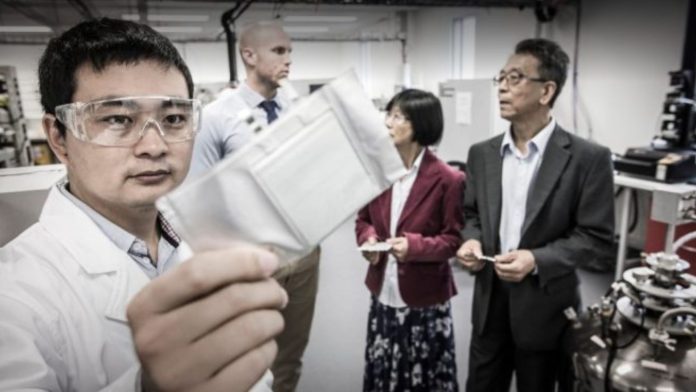
Researchers from the University of Wollongong’s (UOW) Australian Institute for Innovative Materials (AIIM) will convene for a workshop on enhanced energy storage management, an area crucial for the advancement of modern electrical grid management.
The workshop is being organided in partnership with experts from South Korea’s Hanyang University, Seoul National University, Sungkyunkwan University, Konkun University, Kyung Hee University, and Daegu Gyeongbuk Institute of Science and Technology, as well as Japan’s National Institute for Mathematical Sciences and Tokyo University.
The three-day workshop will provide an in-depth understanding of a variety of battery solutions, with researchers discussing the most recent developments in battery materials, modelling, systems, characterisations, electrochemistry, and supercapacitors, all of which are critical components of energy storage.
One of the keynote speakers, AIIM Professor Jung Ho Kim, said the event will bring together the brightest minds in the renewable energy and storage industries.
“Rechargeable batteries are highly desirable for solving future energy crises and environmental pollution. But many technical issues still remain, and batteries are also approaching their performance limits,” Professor Kim stated.
According to Professor Kim, from portable information technology devices to electric cars and power-grid systems, several types of batteries have recently been utilised as universal power sources.
“Ground-breaking technologies are highly required for next-generation high-energy density, solid-electrolyte, cost-concious, long-lasting cycle, less-flammable, and fast-charging batteries,” Professor Kim added.
Professor Kim said, “The workshop will discuss various aspects of the advanced energy storage technologies and innovations that are required for changing energy requirements and advances in storage technologies and gain a systematic understanding of battery management systems and its importance.”









 Australian Institute for Innovative Materials (AIIM) will convene for a workshop on enhanced energy storage management, an area crucial for the advancement of modern electrical grid management.)