
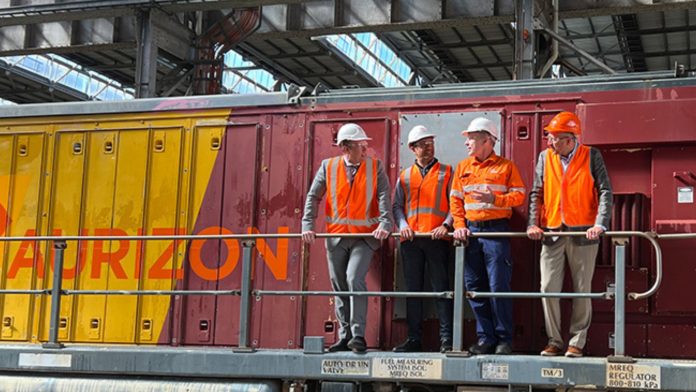
Aurizon has announced the details of its investment to develop Australia’s first zero-emissions freight locomotive.
Aurizon has commissioned Progress Rail, a Caterpillar business and global leader in train technology solutions, to carry out the groundbreaking project. This sort of effort has the potential to lower Australia’s transportation emissions and revolutionise the country’s freight supply networks.
This will be Australia’s first battery-powered freight unit, enabling the possible future usage of completely renewable energy sources for freight hauls. Additionally, as trains brake or descend hills, they produce regenerative energy that batteries will absorb.
Progress Rail’s Redbank site in southeast Queensland is building the prototype. The locomotive will be developed as a heavy-haul freight locomotive capable of operating over Aurizon’s national footprint and suited to Australia’s tough operating conditions.
Progress Rail will retrofit the 4000-class diesel locomotives that are currently in use by Aurizon. Aurizon’s national fleet includes more than 120 4000-class locomotives, implying that a successful battery conversion might provide a considerably faster, less expensive decarbonisation pathway utilising wholly recycled assets.
Aurizon Managing Director & CEO Andrew Harding stated that the project is essential to Aurizon’s decarbonisation ambitions, with a goal of attaining net-zero operational emissions by 2050.
“Modern freight locomotives using renewable energy sources have the potential to transform the nation’s freight supply chains for customers, communities and the Australian economy,” Harding said.
According to Harding, it would drastically reduce the carbon footprint of the company’s freight transport needs and the community’s carbon impact and provide Australian exporters with a competitive edge in global markets.
“Australia is ideally positioned to supply the world with great reserves of future-facing commodities that will fuel and feed a decarbonising world for decades to come. This includes commodities such as copper, nickel, rare earths, grain and phosphate,” he added.
Progress Rail Senior Vice President Colin Kerelchuk stated, “This project leverages our worldwide capabilities, while heavily relying on our expert workforce in Australia. We will deliver this EMD® Joule out of our Redbank, Queensland facility, where we have recently secured a long-term lease extension to continue operations through 2034.”
“With a presence in Queensland since 2015, we are well positioned to deliver broad technology and fleetwide modernizations to improve our customers’ operational and emissions efficiencies,” Kerelchuk said.
Aurizon has also hired the University of Queensland and Central Queensland University to model and research emerging battery technology, network infrastructure, and charging facilities for locomotive batteries.
According to Aurizon, locomotives have an asset life of 20–30 years, therefore replacing the diesel engine with batteries and recycling the rest is cheaper, greener, and circular.
Redbank has begun retrofit design. By early 2025, the locomotive should be ready for on-track trials. The selected Australian rail line will have charging infrastructure installed simultaneously.