
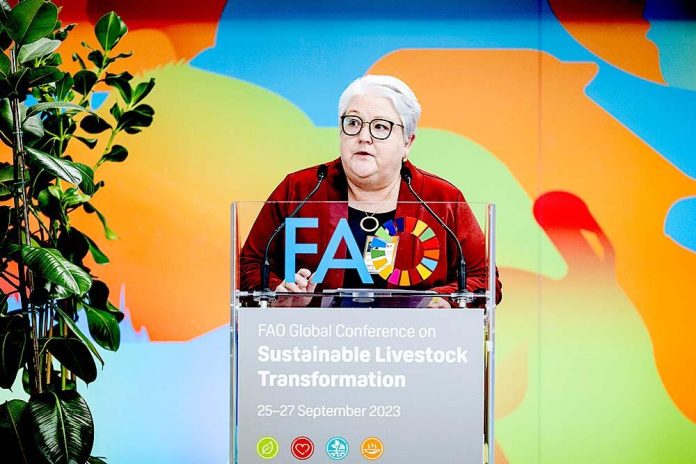
Australia showcased its commitment to livestock sustainability as part of the United Nations Food and Agriculture Organization’s (FAO) inaugural Global Conference on Sustainable Livestock Transformation in Rome, Italy.
The conference aimed to engage FAO Members, producer organisations, research institutions, development agencies, civil society organisations, and private sector bodies in innovative ways to produce nutritious, safe, and accessible animal source foods efficiently, reduce environmental impact, and contribute to resilient local livestock systems.
Australia’s delegation, led by A/g Deputy Secretary Nicola Hinder, Assistant Secretary Peter Creaser, and Agriculture Counsellor Emma Hatcher, included representatives from the Department of Agriculture and Fisheries, CSIRO, and Australian beef, wool, and dairy industries.
Nicola highlighted Australia’s approach to agricultural sustainability, which is outcomes-based and focuses on economic, environmental, and social pillars. She acknowledged that there is no one-size-fits-all approach and highlighted the role of trade in delivering sustainable outcomes, emphasising transparent, predictable, open, and fair markets.
She hosted a CSIRO-led panel session on emerging technologies for livestock methane mitigation and productivity gains, featuring scientists from Australia, Brazil, Spain, and Africa, underscoring the global nature of a science-based approach to sustainability and the importance of developing practices on a country-by-country basis.
Nicola also led a meeting with the Global Livestock Sustainability Youth Panel, involving participants from global livestock communities who challenged speakers on better practices and ways to improve livestock sustainability.
According to the Department of Agriculture, Fisheries and Forestry, the global forum emphasised the significance of innovation for agricultural sustainability.
The Department noted that it is actively seeking ways to collaborate with global partners to enhance the livestock sector, aiming to create a more productive and sustainable one, which will not only boost Australian agriculture’s prosperity but also enhance global food security.