
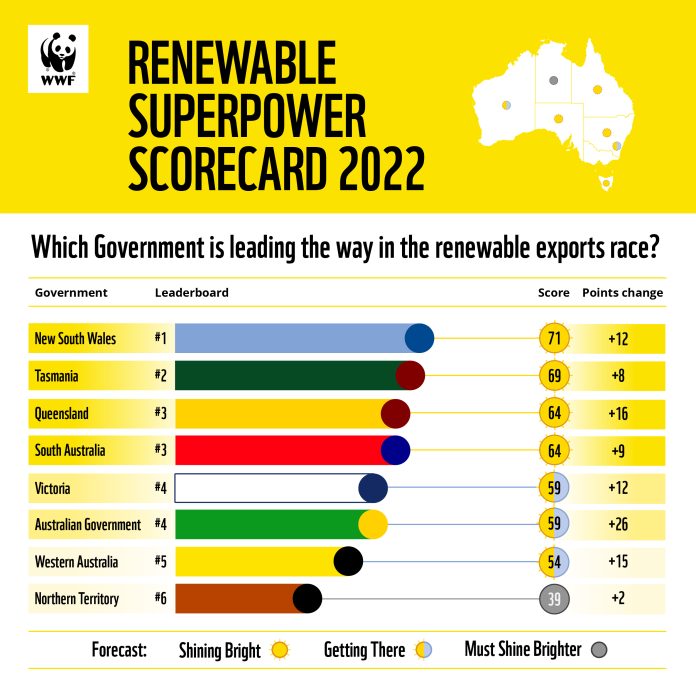
WWF-Australia has released its third Renewable Superpower Scorecard, showing New South Wales has risen to the top of Australia’s race to become a renewable energy superpower.
In a statement, WWF-Australia added that the Australian Government had made the most progress of all jurisdictions (+26 points) due to numerous policy and budget commitments made since the 2022 election.
WWF-Australia CEO Dermot O’Gorman said Australia’s state and federal governments had seen a tumultuous year in the transition to renewable energy.
“Almost daily we are seeing new records for renewable power generation across the nation and increasing investments in renewable energy generation and infrastructure as Australia and the world transition to renewables as the lowest cost energy for the future,” O’Gorman stated.
O’Gorman added that as evidenced by the most recent Renewables Superpower Scorecard, an increasing number of governments are stepping up in what has become a global race to decarbonise economies and seize the renewable energy opportunity.
The newest edition of the Scorecard, which analyses federal, state, and territory governments’ progress towards becoming a world-leading renewable energy superpower, revealed significant policy gains to applaud.
New South Wales took the top spot for the first time thanks to a slew of new policy commitments, including the acceleration of transmission and energy storage projects and the publication of First Nations guidelines for significant energy projects, which aim to ensure that the benefits of the transition are felt across First Nations communities.
Tasmania placed second, continuing to build on its renewable energy strengths with investments in hydrogen and renewable fuels, as well as a commitment to establish sectoral decarbonisation strategies to achieve its legally mandated net zero target of 2030.
Queensland‘s Renewable Energy Target of 70nt per cent renewables by 2032 and 80 per cent renewables by 2035 contributed to a 16-point gain in the rankings.
Victoria gained 12 points in the Scorecard thanks to its Australian-first announcement of an offshore wind target of at least 9 gigatonnes by 2040, while South Australia profited from its Hydrogen Jobs Plan, which includes ambitions to create one of the world’s largest hydrogen electrolyser facilities. Western Australia and the Northern Territory gained ground as well.
However, according to WWF-Australia, this is only the beginning, and much more must be done.
The Clean Energy Investor Group (CEIG) believes that policy vision and stability are crucial to lowering barriers and developing more investable markets.
Clean Energy Investor Group CEO Simon Corbell said its research shows that investor confidence in Australia’s clean energy transition is rising, but strong governmental vision and stability are required to create more investable markets. Corbell stated that robust policy frameworks might make or break investment decisions, thus governments must focus on expanding the number of committed clean energy projects in Australia.
“We welcome WWF-Australia’s Renewable Superpower Scorecard and are pleased to see ambitious plans for storage, transmission and renewable energy zones, which provide a good foundation for export-oriented growth,” he added.
While the speed and scale of these initiatives will be critical, they must also embrace the values of justice among our people and the preservation of the earth.
O’Gorman said Australia is uniquely positioned to redefine its global role – to become a renewables export superpower and true worldwide leader in climate solutions – but we must do it correctly.
“We need to transform our economy from a linear industrial machine to one that is circular, regenerative and purpose-driven, working across supply chains and with our people to find opportunities to truly regenerate nature and our communities,” O’Gorman stated.
O’Gorman added that Australia possesses the expertise, technology, and connection required to create and drive this change, with renewables at the fore.
“To fully harness the huge opportunity we have, we must leverage our current momentum, demonstrate smart and ambitious policy, and drive progress, implementing solutions at speed and scale with communities and nature at the core,” O’Gorman said.