
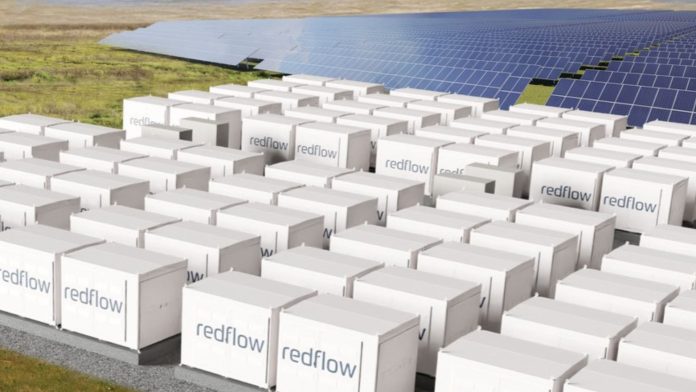
The California Energy Commission (CEC) has funded and authorised Redflow Limited‘s safe, scalable, and sustainable flow batteries for a large-scale solar and storage project that will deliver power to the Paskenta Band of Nomlaki Indians.
The 20 MWh system will be one of the biggest zinc-based battery installations ever as well as Redflow’s biggest single sale and battery deployment in history.
As the CEC works to assemble a strong portfolio of long-duration energy storage projects, Redflow joins a select group of commercially successful non-lithium storage suppliers with this new 20 MWh project. Redflow stated that the projects are an important first step in addressing the anticipated 45–55 GW of long-duration energy storage needed in California by 2045 to ensure grid resilience and the state’s goals for a sustainable energy transition.
The CEC’s US$140 million long-duration energy storage award program will support the initiative, which will enable commercially viable non-lithium energy storage technologies to scale. This is in addition to the 2 MWh system in California that Redflow erected for Anaergia in 2022 and has been operational for more than a year.
“This 20 MWh project is one of several large-scale opportunities in our pipeline, and represents the next phase of our growth strategy, validating our focus on large-scale systems in the U.S. and Australia. The market for long-duration energy storage is accelerating. CEC approval firmly establishes our presence in California, which is leading the development and support of non-lithium technologies to achieve its net-zero goals. This project is a great example of U.S.-Australian collaboration in renewable energy and supports the aims of the recent Climate, Critical Minerals and Clean Energy Transformation Compact, which cites clean energy as the third pillar of the alliance,” Redflow Chief Executive Officer and Managing Director Tim Harris said.
“For this project, Redflow’s battery system is designed to charge from solar and discharge throughout the remainder of the day, reducing grid demand and boosting the energy security of the Paskenta Rancheria,” added Harris. “We’re proud to be working with our partners in California to deliver our proven zinc-bromine flow battery technology and meet California’s need for longer-duration, scalable, zero-fire-risk energy storage solutions.”
Long-term energy storage initiatives supported by the CEC are frequently deployed to benefit marginalised populations while also assisting the state in addressing system stability and resiliency in adverse weather circumstances.
According to Redflow, this solar and storage microgrid will allow the Paskenta Tribe to run the Paskenta Rancheria’s activities with a sustainable, robust renewable energy supply. The initiative is part of the Tribe’s attempts to gain more energy sovereignty by controlling its own energy resources, reducing fossil fuel usage, and demonstrating responsible land stewardship. The award winner and project lead is Faraday Microgrids, a California developer and contractor that has installed a number of CEC grant-funded microgrid systems.
Redflow will provide 2,000 ZBM3 batteries in 200 kWh modular energy pods in 2023 and 2024. The zinc-bromine flow technology developed by Redflow can provide up to 12 hours of variable energy capacity for commercial and utility-scale energy storage applications. The project will add to Redflow’s portfolio of 250 current installations and over 3 GWh of supplied energy.
“The Faraday team is delighted to be working with Redflow on this important project. The resiliency, operational performance, and safety of Redflow’s zinc-bromine flow battery technology will support the sustainability, reliability, and energy self-sufficiency goals of both the State of California and the Paskenta Band of Nomlaki Indians,” said David Bliss, CEO of Faraday Microgrids. “Redflow’s strength of team, innovative approach to flow technology, and a strong track record of successful deployments is a welcome addition to our microgrid portfolio.”
“This project is an important step in California’s clean energy transition,” said Jonah Steinbuck, Director of the Energy Research and Development Division at the California Energy Commission. “It reflects the CEC’s goal to commercialise proven long-duration energy storage solutions and support the energy sovereignty of tribal nations such as the Paskenta Band of Nomlaki Indians. With emerging energy storage technologies such as those developed and deployed by Redflow and Faraday, we will be better positioned to expand and diversify California’s energy storage portfolio, reduce reliance on fossil fuels, and enhance the reliability and resilience of our grid.”
The CEC has formally authorised the entire project and budget for Redflow. Faraday Microgrids and Redflow have inked a final supply agreement for the project’s battery supply and technical support. Faraday Microgrids anticipates that project agreements will be finalised and a notification to Redflow will be given in July 2023.